

Performance Marketing vs Digital Marketing: Which One Is Right for Your Business?
Key takeaways
- Digital marketing is every way you promote a business online.
- Digital marketing is the use of online channels to promote a business and build a relationship with customers.
- Performance marketing is a type of online advertising where you pay based on a result you can measure.
- The easiest way to compare performance marketing vs digital marketing is to look at what each one is built to do.
Ask ten agencies what your business needs and half will say digital marketing while the other half will pitch performance marketing. Both terms get used so loosely that many owners end up paying for something they never fully understood.
The two are related but they do different jobs. Digital marketing is every effort you make online to get found, trusted and chosen. Performance marketing is a smaller part of that where you pay for a clear result such as a click or a lead or a sale.
This guide breaks down both in simple words. You will learn how they differ in cost, speed and tracking. You will also see which one suits your stage of business and how to run them together so your budget works harder. We run SEO and paid ads side by side for clients in more than 12 countries. The advice here draws on what we see in those live accounts every week.
What Is the Difference Between Performance Marketing and Digital Marketing?
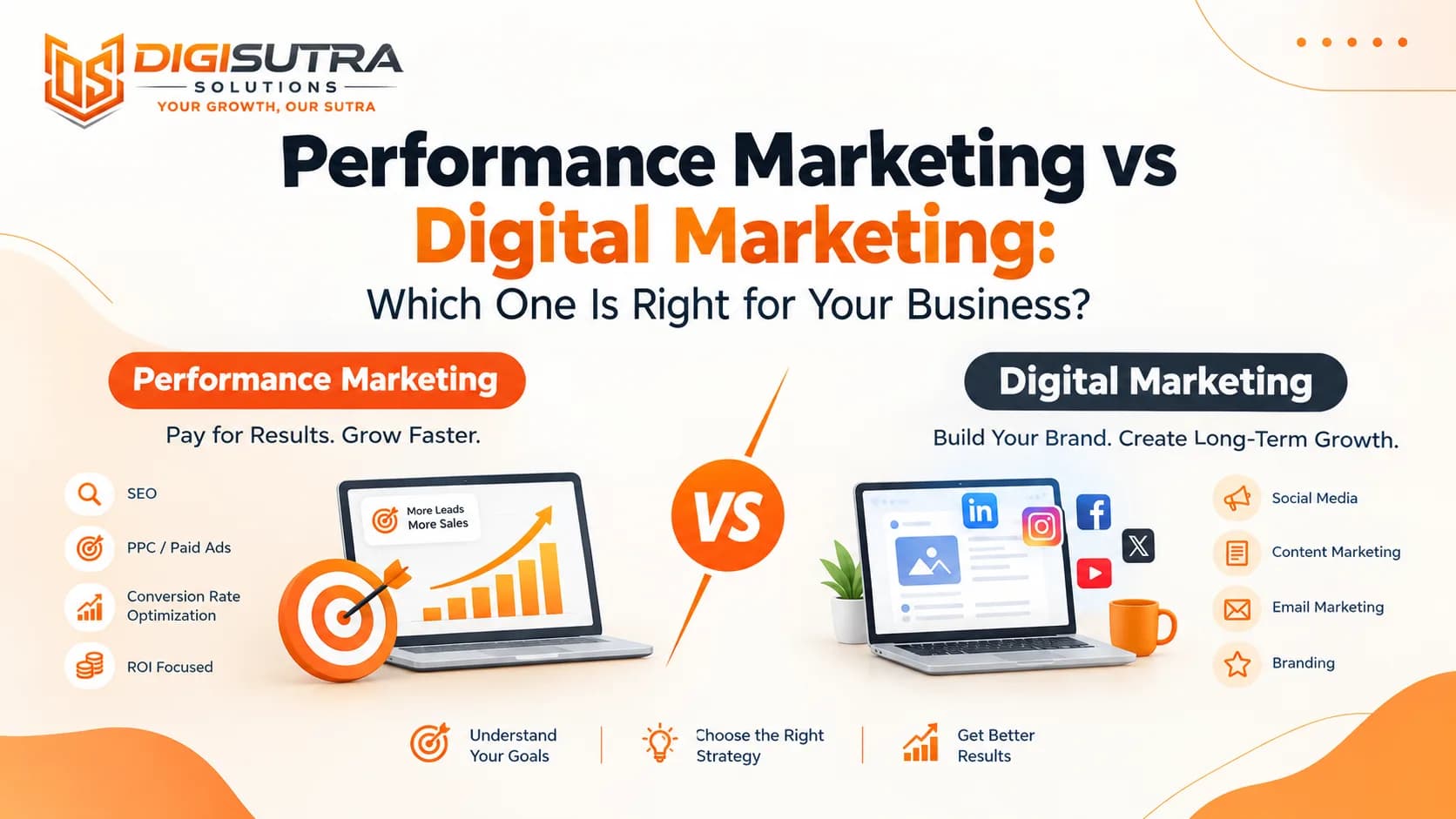
Digital marketing is every way you promote a business online. It covers organic channels like SEO and social posts as well as paid ads. Performance marketing is the paid part of digital marketing. Your spend is tied to a result you can count such as a click, a lead or a sale.
Every performance campaign is a digital campaign but the reverse is not true. A blog post that ranks on Google does not charge you per visit so it sits outside performance marketing even when it brings in leads.
Digital marketing: The full online toolbox with paid and organic channels
Performance marketing: The paid tools where cost follows clicks or leads or sales
Best approach for most businesses: Performance marketing for quick results plus broader digital marketing for lasting growth
What Is Digital Marketing?
Digital marketing is the use of online channels to promote a business and build a relationship with customers. It covers everything from your website and Google rankings to social media posts and email newsletters.
The goal is wide. You want people to know your brand, trust it and come back to it. Some of this work shows results in days. Most of it builds slowly and keeps paying off for years.
A big part of modern digital marketing is being visible wherever people search. That now includes Google as well as AI tools like ChatGPT and Gemini. Good search engine and AI search optimization helps your brand show up in both places without paying for every visit.
Main Channels of Digital Marketing
SEO: Ranking your website on Google and in AI answers for the searches your buyers make
Content marketing: Blogs, guides and videos that answer customer questions
Social media marketing: Organic posts and community building on Instagram or LinkedIn or Facebook
Email and WhatsApp marketing: Direct messages to people who already know you
Website design and UX: A fast and clear site that turns visitors into customers
Paid advertising: Search and social ads which is where performance marketing sits
What Is Performance Marketing?
Performance marketing is a type of online advertising where you pay based on a result you can measure. That result could be a click, a form fill, an app install or a purchase. The money you spend is tied to what actually happens.
It runs mostly on ad platforms such as Google Ads, Meta Ads and LinkedIn Ads. Every dollar or rupee is tracked so you can see which ad brought which sale. If you are new to the idea our guide on performance marketing basics walks through it step by step.
The big appeal is control. You can start a campaign today and see data by tonight. You can pause what fails and put more money into what works.
Common Performance Marketing Pricing Models
Cost per click (CPC): You pay each time someone clicks your ad
Cost per lead (CPL): You pay for each sign-up or enquiry form
Cost per acquisition (CPA): You bid or pay based on each completed sale or sign-up
Cost per install (CPI): You pay for each app download
Affiliate commission: A partner earns a cut of each sale they send your way
Cost per thousand views (CPM): You pay for every thousand times your ad is shown. This is the default billing for most social media ads even when the goal is sales
Main Performance Marketing Channels
Search ads: Google Ads and Microsoft Ads for people already searching for your offer
Shopping and marketplace ads: Google Shopping and Amazon Ads for ready buyers
Paid social: Meta Ads on Facebook and Instagram plus LinkedIn Ads for B2B
Video ads: YouTube campaigns set up to chase sign-ups or sales
Affiliate and creator deals: Partners who earn a commission on each sale
Who Carries the Risk in Performance Marketing?
Many owners think they only pay when a sale happens. On Google and Meta that is rarely true. You are usually billed per click or per thousand views even when the campaign chases sales. If those visitors do not buy you still pay.
Only a few setups like affiliate deals and some lead contracts charge per sale or per qualified lead. So most of the risk still sits with you. That is why tracking and a strong landing page matter so much.
Performance Marketing vs Digital Marketing: Key Differences
The easiest way to compare performance marketing vs digital marketing is to look at what each one is built to do. Digital marketing is the whole toolbox. Performance marketing is one tool inside it that focuses on paid results you can count.
Digital marketing helps people find you and like you over time. Performance marketing pushes them to act now and shows the exact cost of each action.
Side-by-Side Comparison
Factor | Performance marketing | Digital marketing |
Scope | Paid channels tied to results | Every online channel, paid or organic |
Main goal | Leads and sales now | Reach and trust and long-term demand |
How you pay | Spend moves up or down with clicks and leads and sales | Often fixed costs like content and SEO retainers |
Speed | Traffic can start on day one | SEO and content take three to six months |
Tracking | Almost every step is tracked | Some results like brand recall are hard to measure |
Main metrics | ROAS and cost per lead | Organic traffic and branded searches |
Risk | Mostly yours since platforms bill per click or view | Yours too since rankings are never guaranteed |
Scaling | Raise the budget and see more results within days | Grows as content and authority build up |
Staying power | Paid traffic stops when your budget stops | Rankings and content keep working after you stop paying |
Skills needed | Ad buying and data analysis | SEO and content creation |
Best for | Quick wins and scaling a proven offer | Brand building and steady growth |
The table shows why the two rarely compete. One buys results today while the other builds the base that makes those results cheaper tomorrow.
Which Channels Count as Performance Marketing?
Most confusion in the digital marketing vs performance marketing debate comes from channels that can sit on either side. Whether a channel counts depends on how you pay for it and how you judge it.
Channel | Counts as performance marketing? | Why |
Google search and shopping ads | Yes | You pay per click and track each lead or sale |
Meta and LinkedIn ads for leads or sales | Yes | Spend is judged on cost per result |
Affiliate programs | Yes | Partners earn only when a sale happens |
Influencer posts | Sometimes | Only when the creator is paid per sale or per discount code |
Display and video ads bought for reach | Usually no | You pay for views to build awareness |
Email and WhatsApp to your own list | Mostly no | You pay for the tool or per message sent and not per result |
SEO | No | There is no fee per visit even though leads can be tracked |
Content and organic social | No | They build trust and traffic without a cost per result |
A Simple Test to Tell Them Apart
If your cost rises and falls with results and every result is tracked then you are doing performance marketing. If you pay a set amount to build reach or trust or rankings then you are on the wider digital marketing side.
Email and WhatsApp sit close to the line. Your cost does not follow sales but every message can still be tracked to one. That makes well-planned email and WhatsApp campaigns one of the cheapest ways to turn leads from ads into paying customers.
Pros and Cons of Performance Marketing and Digital Marketing
Neither approach is perfect. Each one covers gaps the other leaves open which is why most growing businesses end up using both.
Performance Marketing Pros and Cons
Pros
Results show up within days so you learn fast
Every rupee or dollar can be traced to a click, lead or sale
You can raise or cut spend on any day
Tight targeting by keyword or location or interest or job title
A quick way to test an offer or a price before a bigger launch
Cons
Traffic stops the day your budget stops
Clicks can get expensive in busy markets and peak seasons
You still pay for clicks that never turn into buyers
Ads tire quickly so creatives need regular refreshing
A platform update can shake your results overnight
Broader Digital Marketing Pros and Cons
Pros
Builds assets you own such as rankings and content and an email list
Cost per lead tends to fall as organic traffic grows
Builds the trust that makes every ad work harder
Reaches people early before they are ready to buy
Lowers your exposure to rising ad prices
Cons
Slow start because SEO and content need months to gain traction
Hard to link brand work to one specific sale
Needs steady effort and a wider mix of skills
Rankings and reach are never guaranteed
Search updates can move your traffic up or down
The slow start is the part most owners underestimate. Our breakdown of how long SEO takes to work shows what usually happens month by month so you can judge progress fairly.
How Do Performance Marketing and Digital Marketing Work Together?
You do not have to pick one forever. The strongest growth plans use both because each one covers the weak spot of the other.
Paid ads give you fast data on which keywords and messages sell. Organic work turns that data into rankings and trust that cost less over time. A brand people already know also tends to get cheaper clicks since people are more likely to click a name they recognise.
A solid content marketing plan is often the bridge between the two. It gives your ads better landing pages and gives your organic channels something worth sharing.
Simple Ways to Combine Both
Run search ads first to find which keywords bring sales and then write blog content around those same terms
Retarget people who read your blog or watched your videos with a clear offer ad
Use your best-performing ad copy as headlines for landing pages and emails
Send leads from ads into an email or WhatsApp series so they are not lost after one visit
Test ideas with organic social posts before you put ad money behind them
When Should You Choose Performance Marketing?
Performance marketing makes the most sense when you already know what sells and who buys it. It works like a tap you can turn up or down.
It also needs a strong base. Ads only bring people to your door. If your website is slow or confusing, they leave and you still pay for the click. Before spending on ads make sure you have a fast website built for conversions with clear calls to action.
Signs Performance Marketing Fits Your Business Right Now
You need leads or sales within weeks and not months
You have a clear product or service with a known price
Your website or landing page loads fast and has a simple form or checkout
You can track conversions through tools like GA4 or Meta Pixel
You know roughly how much a new customer is worth to you
You have budget set aside for testing before you judge results
When Should You Choose Broader Digital Marketing?
A full digital marketing plan is the better starting point when people do not know your brand yet or when buyers take time to decide. B2B services and high-ticket products often fall here. Buyers read, compare and ask around before they ever fill a form.
It also suits businesses that want to depend less on ads. Every month you pay for ads you are renting attention. Every blog post that ranks is an asset you own.
A good first step is to check where your site stands today. Our free SEO audit tool can point out the main issues holding your pages back.
Signs a Full Digital Marketing Plan Fits Better
Your brand is new and few people search for it by name
Your sales cycle is long and buyers need trust before they talk to you
Your ad costs keep rising and you want a cheaper source of leads
Your market is crowded and people choose based on reputation
You have a small budget but can wait a few months for organic growth
Example: How Both Approaches Perform Over 12 Months
Here is how the two paths can play out for a local service business with ₹1 lakh to spend each month. The numbers are rounded and made up to show the pattern. Your real costs will depend on your city, industry and competition.
Plan A: The full ₹1 lakh goes into Google Ads at about ₹500 per lead
Plan B: ₹60,000 goes into Google Ads and ₹40,000 goes into SEO and content
Month | Plan A leads | Plan A cost per lead | Plan B leads | Plan B cost per lead |
Month 1 | 200 | ₹500 | 120 | ₹833 |
Month 3 | 200 | ₹500 | 130 | ₹769 |
Month 6 | 200 | ₹500 | 160 | ₹625 |
Month 12 | 200 | ₹500 | 240 | ₹417 |
What the Numbers Show
Plan A wins early because every rupee turns into leads right away
Plan B starts slower while SEO builds up and then overtakes Plan A in the second half of the year
By month 12 Plan B brings 40 more leads a month at a lower cost per lead
If Plan A pauses its ads the leads stop while Plan B keeps its organic leads even in a quiet month
The best real plan often starts close to Plan A and shifts toward Plan B as organic leads grow
Track spend, leads and sales for each channel in a marketing KPI dashboard so you can see your overall cost per lead move every month.
How to Split Your Budget Between the Two
There is no perfect ratio for every business. Your split should follow your stage, your margins and how fast you need cash to come in. The numbers below are a starting point that you can adjust once real data arrives.
Online stores usually lean harder on paid ads because every sale is easy to track. If you sell online our guide on ad strategy for online stores goes deeper into this.
Starting Budget Splits by Business Stage
New business in its first year: Around 60% on performance marketing to test offers and bring early revenue with 40% on SEO and content so organic growth starts early
Growing business: Close to a 50/50 split as organic traffic starts to bring steady leads
Established brand: Around 30 to 40% on performance marketing for launches and peak seasons with the rest on content and SEO and brand building
Ecommerce store: Often 60 to 70% on paid channels with the rest on SEO for product and category pages
How Much Budget Do You Need to Start?
Plan for at least ₹20,000 or about $250 a month for each ad platform you test. Below that the platform struggles to collect enough data to learn who buys.
WordStream and LocaliQ's 2026 benchmark report gives a sense of scale. It puts the average Google Ads cost per lead in the US at $66.69 across industries. At that price a $1,000 test brings roughly 15 leads before any tuning. Costs in your market can be much lower or higher so treat this as a rough guide.
What Metrics Should You Track for Each?
Performance marketing and digital marketing need different scorecards. If you judge SEO by next week's sales you will quit too early. If you judge ads by likes you will waste money.
For paid campaigns the main question is whether each dollar or rupee spent brings back more than it cost. Our free ROI calculator helps you see whether a campaign is making or losing money.
Performance Marketing Metrics
Return on ad spend (ROAS): Revenue earned for every unit of ad spend. Divide revenue by ad spend to get it
Cost per lead or cost per acquisition: What you pay for each lead or sale
Conversion rate: The share of visitors who take the action you want
Click-through rate (CTR): How often people click after seeing your ad
Customer acquisition cost (CAC): Your total cost to win one new customer
Customer lifetime value (LTV): What one customer is worth over time which tells you how much you can afford to pay to win them
Digital Marketing Metrics
Organic traffic: Visitors who find you without paid ads
Keyword rankings: Where your pages sit on Google for target searches
AI search mentions: How often ChatGPT, Gemini or Perplexity name your brand in answers
Branded searches: How many people search for your business by name
Engagement and list growth: Social interactions plus new email or WhatsApp subscribers
One Number That Ties Both Together: Blended Cost per Lead
Blended cost per lead is your total marketing spend divided by all leads from every channel. It shows whether your whole mix is getting cheaper. If it keeps falling while your ad numbers stay flat then your organic work is paying off.
How AI Search Is Changing Performance and Digital Marketing
More buyers now ask ChatGPT or Gemini or Google's AI Overviews before they click on anything. That shift touches both sides of your marketing.
Rankings alone now bring fewer visits. Pew Research Center tracked the browsing of 900 US adults in March 2025. People clicked a regular search result in 8% of visits when Google showed an AI summary and in 15% of visits when it did not. So getting your brand named inside AI answers is now part of digital marketing.
Performance marketing is shifting too. Tools like Google Performance Max and Meta Advantage+ now handle much of the bidding and targeting. Results depend more on clean conversion data and strong creative. Our look at how AI is changing digital marketing covers both shifts in more detail.
How to Adapt Your Marketing Mix for AI Search
Publish clear comparison and how-to content that AI tools can quote
Keep your business details and reviews consistent across the web
Send real lead and sales data back into your ad platforms
Watch branded searches as an early sign that AI tools mention you
Common Mistakes Businesses Make With Both
Most wasted marketing budgets trace back to the same handful of errors. Poor tracking sits behind many of them because without it you cannot tell a good campaign from a bad one.
If you have not done it yet start by setting up GA4 conversion tracking on your website. It takes an afternoon and saves you from guessing for months.
Mistakes to Avoid
Sending ad traffic to a slow homepage instead of a focused landing page
Judging SEO results after one month when it usually needs three to six
Running ads with no conversion tracking in place
Chasing the cheapest clicks instead of the most profitable leads
Cutting all brand and content work once ads start performing
Letting leads sit for days without a call or message
Copying a competitor's budget split without looking at your own numbers
Trusting each ad platform's own report without checking real sales in your CRM or store
Judging awareness ads on sales when they were bought for reach
Performance Marketer vs Digital Marketer: Who Does What?
The job titles cause almost as much confusion as the terms. Knowing the difference helps when you hire someone and when you plan a marketing career.
Area | Performance marketer | Digital marketer |
Main job | Runs paid campaigns that bring leads and sales | Plans how the brand shows up across online channels |
Daily work | Budgets, ad tests and tracking checks | SEO, content, social and email plans |
Key skills | Data analysis and testing | Writing and SEO and brand thinking |
Common tools | Google Ads and Meta Ads Manager and GA4 | Search Console and a CMS plus social and email tools |
Judged on | ROAS and cost per lead | Traffic and rankings and engagement |
Should You Hire a Performance Marketer or a Digital Marketer?
Hire or outsource a performance marketer when most of your budget goes into ads and you need faster leads
Bring in a digital marketing lead or agency when you need one plan across SEO and content and ads
Small teams often start with one all-rounder and add a paid ads specialist once ad spend grows
How to Decide What Is Right for Your Business
If you are still unsure answer a few honest questions about your business. Your answers will point you in the right direction faster than any trend report.
Leads also need a home once they arrive. A simple lead management system makes sure every enquiry from ads or organic search gets a quick follow-up so you do not pay for leads that go cold.
A Simple 5-Step Check
Define your goal: Write down whether you need sales this month or a stronger brand this year
Know your numbers: Work out your average order value and how much you can spend to win one customer
Check your website: Make sure it loads fast and tells visitors what to do next
Pick a starting mix: Use the budget splits above as your base
Review every 30 days: Move money toward the channels that bring the best return
Quick Decision Table by Business Situation
Your situation | Start with |
You need sales this month and have a proven offer | Performance marketing |
You are launching a product or running a sale | Performance marketing |
Few people know your brand yet | Broader digital marketing with light retargeting |
Your buyers take weeks to decide | SEO and content backed by retargeting ads |
Your ad costs keep climbing | More SEO and content to lower your cost per lead |
You have more time than budget | SEO and content and organic social |
You sell online and want steady orders | Both with paid ads leading at first |
Conclusion
Digital marketing and performance marketing work best as partners. Digital marketing is the full picture of how your brand shows up online. Performance marketing is the paid part of it that chases clear results you can measure and scale.
If you need fast leads and already have a proven offer start with performance marketing. If your brand is new or your buyers take time to decide put SEO and content first. Most businesses end up needing both in a mix that shifts as they grow.
Track what matters and review your numbers every month and let the data guide your budget. If you want help finding the right mix the team at Digisutra Solutions can review your numbers and build a plan around your goals.
Frequently Asked Questions
What is the main difference between performance marketing and digital marketing?
Digital marketing covers all online marketing activity, including SEO, content, social media and email. Performance marketing is the paid part of it where you pay for measurable results like clicks, leads or sales.
Is performance marketing a part of digital marketing?
Yes. Performance marketing sits inside digital marketing. It focuses on paid channels where every result is tracked and costs are tied to outcomes.
Is SEO part of performance marketing?
Not in the strict sense. SEO belongs to digital marketing because you do not pay per click or per lead. You can still judge SEO by results like leads and sales which is why some agencies group it under performance-led marketing.
Is performance marketing the same as PPC?
No. Pay per click is one billing model inside performance marketing. Performance marketing also covers cost per lead deals, affiliate commissions and campaigns judged on cost per sale.
Which is better for a small business?
It depends on your goal. If you need sales quickly and have a clear offer start with performance marketing. If you have more time than budget start with SEO and content and add paid ads later.
Which is more cost-effective in the long run?
Organic digital marketing usually wins over time because ranking pages and email lists keep bringing leads without a fee per click. Performance marketing is more cost-effective when you need results fast or want to test an offer before you invest in content.
How fast does performance marketing show results?
Paid campaigns can bring traffic on the first day. Most businesses need two to four weeks of testing before costs settle and results become steady.
How long does digital marketing take to work?
Channels like SEO and content usually take three to six months to show strong results. Email and social media can show activity sooner but steady growth still takes time.
Is performance marketing expensive?
It can be as small or as large as you set it. You control the daily budget and can pause campaigns anytime. Most businesses should plan at least ₹20,000 or about $250 a month per ad platform so it has enough data to learn. The real cost depends on your industry, your competition and how well your website converts.
What channels are used in performance marketing?
The main ones are Google Ads and Meta Ads (Facebook and Instagram), LinkedIn Ads and Amazon Ads. Affiliate marketing and some influencer deals also work on a pay-for-results model.
Can I do SEO and performance marketing at the same time?
Yes and it often works better that way. Ads bring quick data and sales while SEO builds free traffic over time. Keyword data from your ads can also guide your SEO content.
What is a good ROAS for performance marketing?
Many businesses aim for a ROAS of 3:1 or better. The right number depends on your profit margins so work backward from what you need to stay profitable.
How do I know if my marketing is working?
Set clear goals before you start and track them in a tool like GA4. For ads watch cost per lead and ROAS. For digital marketing watch organic traffic, rankings and branded searches over several months.
Is performance marketing or digital marketing a better career?
Neither path wins on its own. Performance marketing suits people who enjoy numbers and testing and fast feedback. Broader digital marketing suits people who like writing and SEO and brand building. Many marketers learn the basics of both and then specialise once they know what they enjoy.
About the author

Sr. SEO Executive · 3 years' experience
Harsh Rajput is a Senior SEO Executive with 3+ years of experience in SEO, digital marketing and AEO/GEO strategy. He leads a team of SEO executives at Digisutra Solutions, handling keyword research, technical SEO, on-page/off-page optimization, link building and content strategy, while helping brands rank in Google AI Overviews and LLM platforms like ChatGPT, Claude and Gemini. He has worked with clients across India, USA, UAE, and Australia in industries like e-commerce, finance and technology.
Reader reviews
Up next · Marketing & ads · 17 min
What Is Influencer Marketing and How It Works for Brands

Related · AI automation · 20 min
What Custom AI Development Means for a Business