

How Long Does SEO Take to Show Results?

Harsh Rajput · Sr. SEO Executive · 3 years' experience · 5 August 2026 · Updated 1 September 2026 · 17 min read
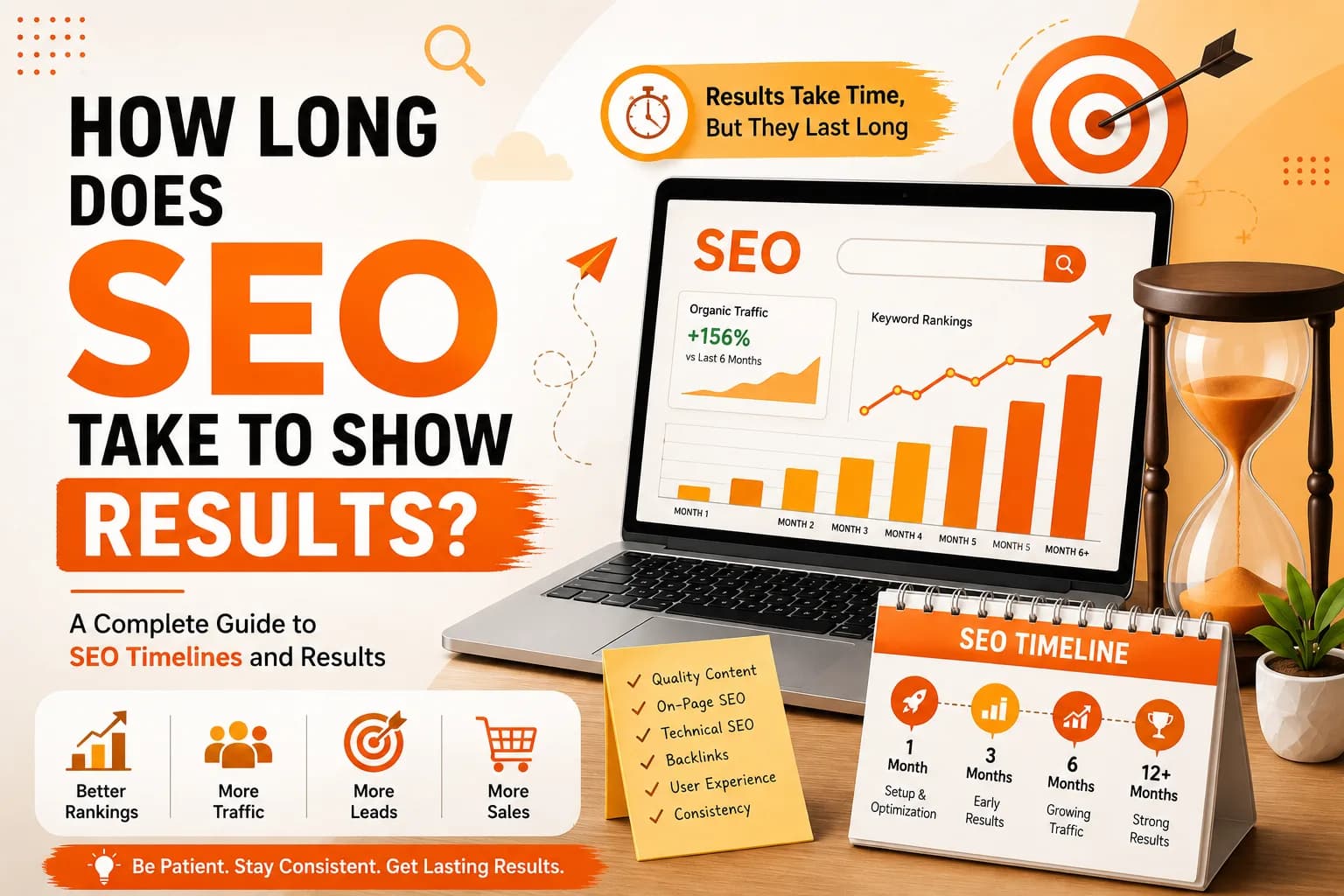
Key takeaways
- Most websites see measurable SEO results in 3 to 6 months and meaningful revenue in 6 to 12 months.
- This is the shape of a typical engagement on a small to mid-sized site.
- Seven things move the date more than anything else.
- This is the part most SEO timelines still ignore.
Almost every business that starts SEO hits the same wall in month two. Nothing has moved. The invoice has been paid twice. And a quiet doubt sets in about whether any of this is working.
Here is the thing nobody explains properly at the start. SEO does work but it reports late. Rankings are the last thing to change not the first. Before a keyword moves Google has to crawl your pages, understand what they cover, compare them against every other site chasing the same query and then decide whether to trust you enough to test you in the results. That chain takes months.
This guide gives you the timeline that holds up in practice. You get a month-by-month breakdown, realistic ranges by business type, the early signals that prove your SEO is working long before rankings shift, how long AI search visibility takes now that ChatGPT and AI Overviews sit between your page and your customer, and a straight answer on how long to give an agency before you walk away.
The Short Answer on SEO Timelines
Most websites see measurable SEO results in 3 to 6 months and meaningful revenue in 6 to 12 months. A brand new domain in a competitive niche often needs 12 to 18 months before the numbers get exciting.
That range is wide because "results" means four different things and they do not arrive together. Google's own long-standing guidance puts the window at four months to a year, which lines up with what most agencies see in the field.
What arrives, and when
Weeks 1 to 4 — fixed pages get re-crawled and re-indexed. No ranking movement yet and that is normal.
Weeks 4 to 10 — impressions climb in Search Console. Google is testing you across more queries.
Months 3 to 5 — long-tail keywords land on page one or two. Your first real clicks show up.
Months 5 to 8 — mid-competition terms settle. Leads and enquiries begin.
Months 8 to 12 — head terms start moving. Revenue becomes predictable enough to forecast.
Month 12 onward — compounding. New pages rank faster because the domain has earned trust.
The reason nobody can give you a hard date for how long does SEO take to see results is that two sites starting the same Monday can end the year a mile apart. Domain history, competition and how fast your dev team ships changes will all pull the date around.
A Month-by-Month SEO Timeline You Can Actually Track
This is the shape of a typical engagement on a small to mid-sized site. Treat it as a benchmark you measure against, not a promise.
Month | What the team is doing | What you should see | What you should not expect |
1 | Technical audit, Search Console and GA4 setup, keyword mapping, competitor benchmarking | A written roadmap and a baseline report | Any ranking change |
2 | Fixing crawl and index errors, speed work, rewriting priority page titles and headings | Fewer errors in Search Console, faster re-crawls | Traffic growth |
3 | Publishing optimised pages, internal linking, schema markup | Impressions rising, a few long-tail terms appearing on page 3 to 5 | Page one rankings |
4 | Continued publishing, first link outreach, on-page refinement | More impressions, visible ranking movement, some volatility | Stability |
5 | Content expansion, link acquisition, conversion fixes | First long-tail terms on page one, first organic clicks | Head term movement |
6 | Performance review, strategy adjustment for next quarter | Consistent traffic growth, first organic leads | Full ROI |
7 to 9 | Scaling what worked, deepening topic clusters | Rankings stabilising, mid-competition terms climbing, repeatable leads | Category dominance |
10 to 12 | Authority building, refreshing older pages, expanding coverage | Head terms entering page one or two, revenue you can forecast | To be finished |
12+ | Refresh cycles, new clusters, competitive terms | Compounding growth, new pages ranking faster | To stop and hold position |
How to read this table properly
Month 1 and 2 look like nothing is happening. That is the work with the longest lag and the highest leverage.
Volatility in month 4 is a sign of progress, not failure. Google often shifts a changed page around before settling it.
If month 6 shows no impression growth at all, something is genuinely wrong. That is a checkpoint, not a panic point.
Running a full technical crawl of your site at month 1 and again at month 6 gives you a clean before-and-after that clients understand instantly.
What Actually Decides Your Timeline
Seven things move the date more than anything else. The seventh is the one that quietly wrecks most campaigns and almost nobody bills for it.
The seven factors that set your pace
Domain age and history. An older domain with existing links and clean history moves faster. A new domain has no trust signals to lean on, so Google evaluates it carefully before letting it compete. You can check your domain's current strength in about thirty seconds and set expectations from there.
Backlink profile. This is still one of the biggest levers. Sites with relevant, earned links from trusted places rank faster because Google already has a reason to believe them.
Keyword difficulty. A three-word commercial term dominated by national brands is a two-year project. A specific long-tail question is often a two-month project. Most timelines break because someone picked the wrong first target.
Technical health. If Googlebot cannot crawl your site efficiently your best content sits invisible. Slow servers, heavy JavaScript rendering, broken canonicals and redirect chains all add weeks. Keeping the site clean through ongoing maintenance and security work removes that drag permanently.
Content depth and consistency. Publishing well every month beats publishing everything in one burst then going quiet. Consistency builds topical authority. Bursts build nothing.
Budget and resources. Below roughly $1,500 to $2,000 a month it is very hard to run technical, content and link work properly at the same time. You end up doing one of the three and the timeline stretches accordingly.
Implementation speed. Your SEO team can hand over 40 fixes in week three. If your developers ship them in week twenty, your timeline just moved four months to the right. This is the most common hidden reason SEO underperforms, and it has nothing to do with the SEO.
How Long SEO Takes by Business Type
Averages hide a lot. Here is the same question answered by situation.
Business type | First movement | Meaningful traffic | Real revenue impact | Why |
Local service business | 4 to 8 weeks | 2 to 4 months | 4 to 6 months | Smaller competitor pool and Google Business Profile does heavy lifting |
Established SMB site | 6 to 10 weeks | 3 to 5 months | 5 to 8 months | Existing authority accelerates everything |
Brand new website | 3 to 4 months | 6 to 9 months | 9 to 15 months | No trust signals, no link history, no branded demand |
Ecommerce store | 2 to 3 months | 4 to 7 months | 6 to 10 months | Category and product pages compete against marketplaces |
B2B or SaaS | 3 to 4 months | 5 to 8 months | 8 to 14 months | Long sales cycles delay attributable revenue even after rankings arrive |
YMYL — health, finance, legal | 4 to 6 months | 8 to 12 months | 12 to 18 months | Google applies stricter trust and credentials standards |
Where each type should spend the first 90 days
Local business — Google Business Profile, reviews, location pages and local citations before anything else. A quick Google Business Profile audit usually surfaces two or three fixes worth more than a month of blogging.
New website — technical foundations and long-tail informational content. Do not touch competitive head terms yet.
Ecommerce — category page optimisation and product schema first. Blog content second.
B2B and SaaS — comparison pages, alternatives pages and bottom-of-funnel content. They convert far better than top-of-funnel guides and often rank with fewer links.
YMYL — author credentials, editorial policy, citations and expert review before a single new article goes live.
How Long AI Search Visibility Takes
This is the part most SEO timelines still ignore. Ranking in Google is no longer the only finish line. Your buyers are asking ChatGPT, Perplexity and Gemini, and those systems run on different clocks.
The short version is that AI visibility can move faster than traditional rankings, but it decays much faster too.
Platform | Typical time to first citation | What gates it |
ChatGPT with web search | 3 to 14 days after Bing indexation | Bing index, not Google. Different pipeline entirely |
Google AI Overviews | 2 to 6 weeks | Google index plus quality and trust filters |
Perplexity | 1 to 4 weeks | Freshness and clear source attribution |
Base model training data | 3 to 18 months | Model release cycles. Not something you can rush |
Sustained citation across platforms | 3 to 6 months | Consistent entity signals and repeated mentions |
What actually gets a page cited
Get indexed in Bing, not just Google. Submit your sitemap to Bing Webmaster Tools. Most sites skip this and then wonder why ChatGPT never mentions them.
Put a direct answer in the first 100 words under each heading. AI systems lift clean, self-contained answers. Buried answers get skipped.
Use comparison and list formats. These get cited faster than long narrative guides across almost every platform.
Refresh regularly. Citation lifespan is short. Research across millions of citation events puts the median half-life at roughly four to five weeks, which means content that sat still last month is already fading from AI answers.
Watch the 90-day mark. If a page has not been cited within about 90 days of indexation, it usually needs a structural rewrite of the title, URL and opening answer rather than more waiting.
Build entity consistency. Same business name, same description, same details everywhere. Confused entities do not get cited.
The practical takeaway is that AI search rewards structure and freshness more than raw domain authority. That makes it the fastest available win for a smaller site, and it is exactly where a focused SEO and AI search programme pays back sooner than traditional rankings do.
Proof Your SEO Is Working Before Rankings Move
You do not have to sit in the dark for six months. These signals appear far earlier than rankings and they are the ones to hold your team to.
Leading indicators to check monthly
Impressions in Search Console. The single best early signal. Rising impressions mean Google is surfacing you for more queries even when positions look flat.
Number of ranking keywords. Going from 40 keywords to 300 keywords is progress even if none of them are on page one yet.
Average position trend by page. Site-wide average is noise. Position on your five priority pages is signal.
Indexed page count. More valid indexed pages and fewer excluded ones means the technical work is landing.
Crawl frequency. Google crawling you more often means it now thinks your site is worth revisiting.
Branded search volume. Rising branded searches means the brand-building side is working, which feeds everything else.
Referring domains. Slow steady growth. Spikes from cheap sources are a warning sign, not a win.
Track these in one place. A simple live KPI dashboard beats a monthly PDF nobody opens, and it keeps the conversation on trend lines instead of daily rank noise.
Why Rankings Sometimes Drop Before They Rise
This one catches people out badly. You make a genuine improvement to a page and it falls. It looks like the change backfired.
It usually has not. Google holds a patent describing a mechanism where ranking changes get phased in over time rather than applied instantly, sometimes with a temporary dip before the page settles at its new position. The logic is sensible. If the algorithm reacted instantly to every change, manipulating it would be trivial.
What to do when a page dips after an update
Wait at least 30 days before reversing anything. Most dips resolve on their own.
Check the obvious first. Confirm nothing broke technically — a stray noindex, a bad canonical, a redirect loop.
Compare like with like. Compare the same 28-day window year on year, not this week against last week.
Watch impressions, not position. If impressions are still climbing while position wobbles, the page is being re-evaluated, not demoted.
Do not stack changes. Changing the title, the content and the internal links in the same week means you learn nothing from the outcome.
How Much Time SEO Actually Takes Each Month
A question that gets asked constantly and answered almost nowhere. Here is a realistic breakdown for a small to mid-sized site.
Task | Time needed | How often |
Full technical audit | 8 to 20 hours | Once, then every 6 months |
Keyword research for a new cluster | 4 to 10 hours | Once per cluster |
Writing and optimising one solid article | 5 to 9 hours | Per article |
On-page optimisation of an existing page | 1 to 2 hours | Per page |
Internal linking review | 2 to 4 hours | Monthly |
Link outreach | 8 to 15 hours | Monthly |
Reporting and analysis | 3 to 5 hours | Monthly |
Realistic monthly total | 30 to 60 hours | Ongoing |
Where to spend the hours if you only have twenty
Fix anything blocking crawling or indexing. Nothing else matters until this is clean.
Optimise your five highest-value existing pages before writing anything new.
Publish one genuinely good article rather than four thin ones.
Spend two hours on internal linking. It is the highest return per hour in SEO and it costs nothing.
Do proper research before you write. Starting from a real keyword and topic research pass prevents the most expensive mistake, which is publishing content for a query nobody searches.
How to Speed Up SEO Results Safely
You cannot make SEO instant. You can remove the things slowing it down.
Six things that genuinely compress the timeline
Ship fixes fast. Cut the gap between recommendation and deployment. This is worth more than any tactic on this list.
Start with long-tail terms. Winning fifteen specific questions builds the authority you need to compete for the broad term later. Going straight for the broad term wins nothing for two years.
Improve existing pages before writing new ones. A page already at position 14 needs far less work to reach page one than a blank page needs to reach position 14.
Fix internal linking properly. Pass authority from your strongest pages to the ones you want to rank. Free, fast and consistently underused.
Publish content people would actually send to a customer. If you would not share it in an email, it will not earn links or citations.
Run paid search alongside for the first six months. Ads do not improve rankings, but they keep leads coming while SEO matures and the search term data tells you which keywords actually convert. Pairing organic work with paid campaign management is the standard way to survive the waiting period without panic.
Skip anything promising instant rankings. Bought links and mass-generated content produce a spike then a collapse, and cleaning up afterwards costs more than doing it right the first time.
How Long to Give an SEO Agency Before You Walk
A fair question that deserves a direct answer. Use checkpoints, not gut feel.
The three checkpoints that matter
Month 3 — are they doing the work? You should see a completed audit, a keyword map, published or optimised pages and a clear list of what shipped. You should not expect rankings. If there is no evidence of work at month three, that is your answer.
Month 6 — is anything moving? Impressions should be up. Ranking keyword count should be up. Some long-tail terms should be on page one or two. If every metric is flat at month six, ask for a root cause. A good team will have one. A weak team will blame the algorithm.
Month 9 to 12 — is it converting? By now there should be organic leads or sales you can point at. If traffic grew but conversions did not, the problem may be the site rather than the SEO, and that is worth diagnosing before you change agency.
Red flags worth acting on immediately
Guaranteed rankings or guaranteed timelines
No access to your own Search Console or Analytics
Reports full of position numbers and nothing about leads or revenue
Content published without your review
No clear answer when you ask what shipped last month
Before you make the call, run the numbers. A quick return on investment calculation using your actual close rate and average deal value usually reframes the conversation. Plenty of campaigns that feel slow are already profitable, and plenty of campaigns that feel busy are not.
SEO Timeline Myths Worth Dropping
Four claims that will cost you money
"You will see results in 30 days." Thirty days is barely enough for a proper audit and keyword map. Anyone promising rankings in that window is either targeting keywords nobody searches or doing something you will regret.
"More content means faster results." Publishing volume without strategy dilutes crawl budget and drags quality signals down. One strong page beats ten thin ones every time.
"Once you rank you stay there." Rankings are rented. Competitors improve, algorithms change and SERP layouts shift. Research tracking sites over a year found that most pages reaching the top ten did not stay there.
"SEO is a one-time project." It is closer to a gym membership than a renovation. Stop and the results fade, slowly at first and then faster. Keeping a steady content programme running is what turns a six-month campaign into a five-year asset.
Conclusion
SEO takes 3 to 6 months to show measurable results and 6 to 12 months to move revenue for most businesses. New sites and regulated industries take longer. Local businesses often move faster.
What matters more than the average is knowing which signals to watch while you wait. Impressions, ranking keyword count and indexed pages all move months before revenue does, and they tell you whether the work is landing long before the money shows up. If those numbers are climbing, stay the course. If they are flat at month six, stop and find out why instead of spending another six months hoping.
The businesses that win at SEO are rarely the ones with the biggest budgets. They are the ones that picked realistic targets, shipped fixes quickly and did not quit in month three when the graph still looked flat. That is the whole trick.
Frequently Asked Questions
1. How long does SEO take to see results?
Most sites see measurable results in 3 to 6 months and meaningful revenue in 6 to 12 months. New domains in competitive niches often need 12 to 18 months.
2. How long does SEO take for a brand new website?
Expect 3 to 4 months before any real movement and 9 to 15 months before revenue impact. New domains have no link history or branded demand, so Google evaluates them slowly.
3. How long do SEO changes take to show up in Google?
Google usually re-crawls a changed page within days to a few weeks depending on how often it crawls your site. Ranking impact typically follows 4 to 12 weeks after that.
4. How long does keyword research take?
Around 4 to 10 hours for a proper cluster on a small to mid-sized site. Large sites or complex product catalogues can take 20 to 40 hours for full mapping.
5. How much time does SEO take each month?
A realistic ongoing programme runs 30 to 60 hours a month across technical work, content, links and reporting. Below about 15 hours a month, progress is very slow.
6. How long does local SEO take?
Local SEO often moves faster than national SEO. Many local businesses see movement in 4 to 8 weeks and real enquiry volume in 4 to 6 months, largely because Google Business Profile carries so much weight.
7. How long does it take to appear in ChatGPT or AI Overviews?
A well-structured page can be cited in ChatGPT within 3 to 14 days of being indexed in Bing, and in AI Overviews within 2 to 6 weeks. Consistent citation across platforms takes 3 to 6 months.
8. Why did my rankings drop after I improved my page?
Google phases ranking changes in over time and pages often dip temporarily before settling higher. Wait about 30 days before reversing anything, and check nothing broke technically first.
9. How long should I give an SEO agency before changing?
Three months to prove work is happening, six months to prove metrics are moving and nine to twelve months to prove it converts. Judge each checkpoint on the right metric rather than expecting rankings at month three.
10. Can SEO work faster than three months?
Sometimes. Low-competition long-tail keywords, local searches with few competitors and established domains with strong existing authority can all show movement in 4 to 8 weeks. Competitive commercial terms cannot.
About the author
Sr. SEO Executive · 3 years' experience
Harsh Rajput is a Senior SEO Executive with 3+ years of experience in SEO, digital marketing and AEO/GEO strategy. He leads a team of SEO executives at Digisutra Solutions, handling keyword research, technical SEO, on-page/off-page optimization, link building and content strategy, while helping brands rank in Google AI Overviews and LLM platforms like ChatGPT, Claude and Gemini. He has worked with clients across India, USA, UAE, and Australia in industries like e-commerce, finance and technology.
Reader reviews

Up next · SEO & AI search · 21 min
Technical SEO Audit Checklist Covering 47 Issues That Can Hurt Your Rankings

Related · SEO & AI search · 16 min
How to Create an XML Sitemap and Submit It to Google