
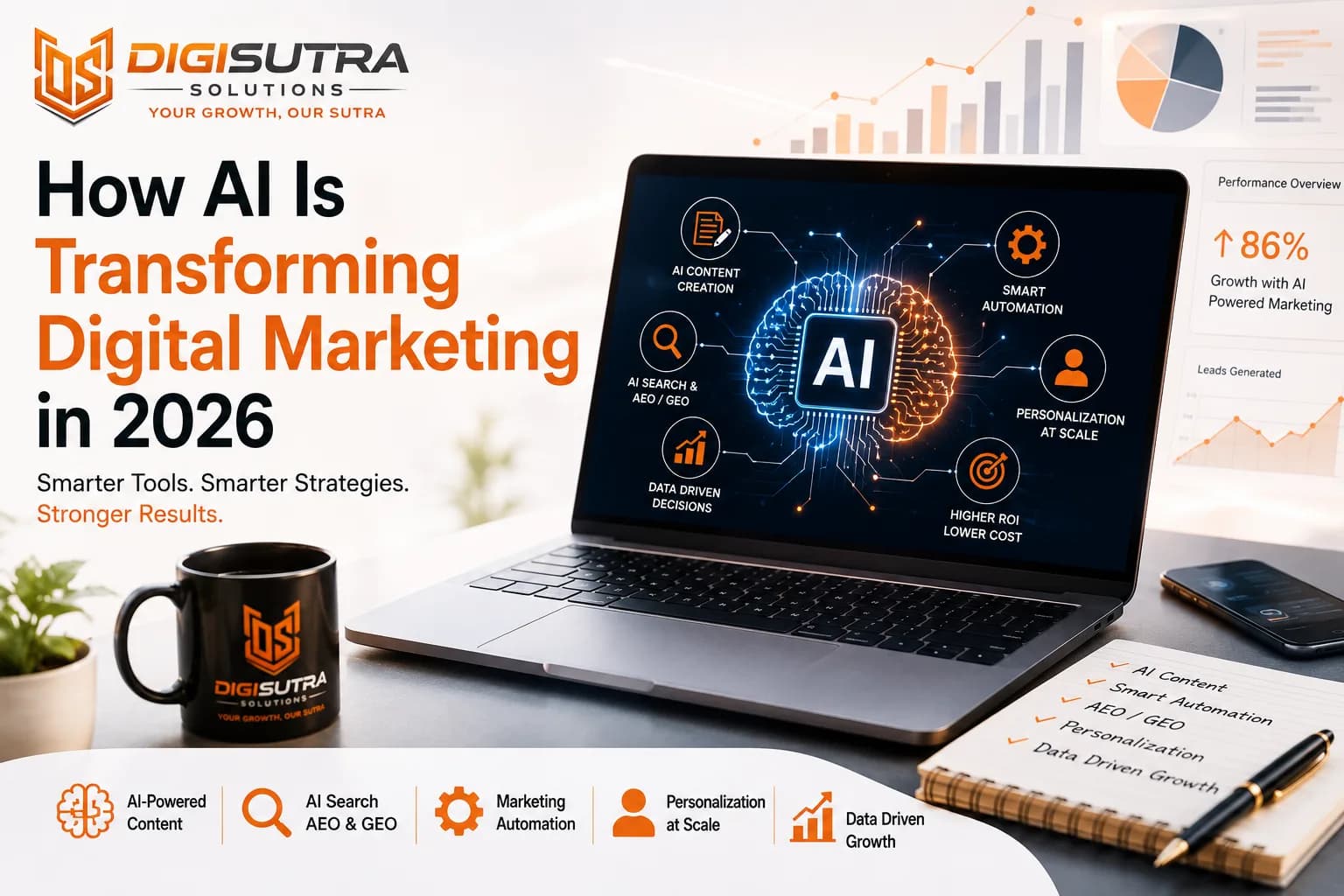
How AI Is Transforming Digital Marketing in 2026

Harsh Rajput · Sr. SEO Executive · 3 years' experience · 31 August 2026 · Updated 7 September 2026 · 11 min read
Key takeaways
- Marketing has always been about reaching the right person with the right message at the right time.
- Writing used to be the biggest bottleneck in any marketing team.
- Search itself looks different in 2026.
- Most AI tools so far have worked by suggesting something and waiting for a person to approve it.
Marketing teams work differently now than they did even two years back. Tasks that once took a full week like building a campaign brief or writing ad variations, now take an afternoon. AI tools sit inside almost every part of the workflow from research to reporting. Some brands use AI quietly in the background. Others have rebuilt entire teams around it. Either way, the shift is real and it's not slowing down. This guide breaks down where AI is actually making a difference right now and what marketers need to know to keep up.
Why AI Matters More in 2026 Than Ever Before
Marketing has always been about reaching the right person with the right message at the right time. AI just makes that far more precise. Search engines answer questions directly instead of just listing links. Ad platforms adjust bids in real time based on thousands of signals. Customers expect instant, relevant responses whether they're chatting with a brand or scrolling their feed.
This is exactly why AI in digital marketing 2026 has become a core part of business strategy rather than a side experiment. Teams that adopted AI in digital marketing 2026 early are already seeing lower costs per lead and faster campaign turnaround.
What Changed Since 2023
AI models got noticeably better at understanding context and intent
Search engines started generating direct answers instead of just ranking pages
Ad platforms shifted almost entirely to automated bidding
Customers began interacting with AI chat tools as a normal part of research
Smaller teams gained access to tools that used to require large budgets
AI in Content Creation and Copywriting
Writing used to be the biggest bottleneck in any marketing team. A single blog post could take days once you factor in research, drafting and editing. AI has cut that timeline down significantly without cutting quality, as long as a human still reviews and shapes the final version.
How Teams Use AI for Content Today
Drafting first versions of blog posts, product descriptions and email copy
Generating multiple headline or ad copy variations to test quickly
Repurposing one long article into social posts, scripts and newsletters
Checking tone and readability before publishing
Summarizing long research documents into usable content briefs
Teams that still write everything from scratch manually are simply slower now. A dedicated AI blog writing tool can produce a strong first draft in minutes, leaving more time for the parts that actually need a human touch like strategy and voice.
AI in Search and Answer Engine Visibility
Search itself looks different in 2026. Google shows AI-generated summaries above the usual results for a large share of queries. People also ask questions directly inside ChatGPT, Gemini and Perplexity instead of typing into a search bar. This means ranking well on a search results page is no longer the only goal.
What Brands Need to Optimize For Now
Traditional SEO rankings on Google and Bing
Featured snippet and direct answer eligibility
Being cited inside AI Overviews and generative search summaries
Visibility inside LLM platforms when someone asks a related question
Clear, factual, well-structured content that AI systems can extract easily
This broader approach is usually called AEO or GEO, short for answer engine optimization and generative engine optimization. It works alongside SEO rather than replacing it. A structured SEO and AI search approach helps a brand show up both in classic search results and inside AI-generated answers. Voice search and image-based search are growing alongside this too, so content written in a natural, question-and-answer style tends to perform better across all three: typed search, voice search and AI chat.
Agentic AI: Marketing That Acts on Its Own
Most AI tools so far have worked by suggesting something and waiting for a person to approve it. Agentic AI goes a step further. It doesn't just recommend a bid change or a subject line, it makes the change, watches how it performs and keeps adjusting on its own within limits a marketer sets in advance.
What Agentic AI Actually Looks Like Day to Day
Setting a goal like "increase qualified leads by 15% this month" instead of a specific task
The system testing ad copy variations on its own and keeping what works
Budget shifting automatically toward the channel performing best that week
Follow-up emails going out based on how a lead actually behaves
A human checking in on results weekly rather than approving every single action
This is still early and needs clear boundaries. A team using it should define exactly what the system can decide on its own and what still needs a person to sign off, the same way you would with a new employee.
AI in Social Media Marketing
Social platforms reward fast, consistent, well-made content, and that's exactly where AI has made the biggest dent in how much a small team can realistically produce.
Where AI Shows Up in Social Media Work
Turning a script into a short video in hours instead of days
Suggesting the best time to post based on when an audience is actually active
Reading comments and messages to gauge whether sentiment is turning negative early
Spotting the right influencers to work with based on real engagement, not just follower count
Predicting roughly how a post will perform before it goes live
None of this replaces a real content strategy. It just means the same strategy can now be executed across more platforms without a bigger team.
AI in Paid Advertising and Campaign Management
Paid ads have quietly become almost fully automated on the backend. Platforms like Google Ads and Meta now handle bidding, audience targeting and budget shifts using machine learning models trained on massive amounts of performance data.
Where AI Now Handles the Heavy Lifting
Real time bid adjustments based on likelihood to convert
Automatic audience expansion once a campaign has enough data
Creative testing across dozens of ad variations at once
Budget reallocation toward the best performing channels
Predicting which leads are most likely to actually convert
Marketers still set the strategy and the guardrails but the manual, hour by hour tweaking is mostly gone. Agencies running performance marketing campaigns now spend more time on strategy and creative direction than on manual bid management.
AI in Customer Support and Conversational Marketing
Customers expect a fast response no matter when they reach out. AI chatbots now handle a large share of first-contact questions across websites, WhatsApp and social media, freeing up human agents for the conversations that actually need a person.
Common Uses of AI in Customer Interaction
Answering frequently asked questions instantly at any hour
Qualifying leads before handing them to a sales rep
Recommending products based on browsing or chat history
Sending automated but personalized follow-ups
Collecting feedback right after a purchase or support chat
A well-built AI chatbot can be trained on a brand's own product catalog and tone, so responses feel consistent rather than generic.
AI-Powered Personalization at Scale
Generic marketing messages get ignored. AI makes it possible to personalize content, offers and product recommendations for thousands of customers at once, something that used to require a huge manual segmentation effort.
How Personalization Works in Practice
Product recommendations based on past purchases or browsing behavior
Email subject lines and send times adjusted per individual recipient
Website content that changes based on visitor location or interest
Dynamic pricing or offers shown to different customer segments
Predicting churn risk before a customer actually leaves
The result is marketing that feels one to one even when it's running for a massive audience.
Measuring What Actually Works
More automation also means more data, and teams need a clear way to separate what's genuinely working from what just looks busy. AI helps here too by spotting patterns across channels far faster than a manual spreadsheet review ever could.
What to Track Regularly
Cost per lead and cost per acquisition across every channel
Conversion rate from AI-assisted campaigns versus manual ones
Engagement on AI-generated versus human-written content
Return on ad spend by campaign and by audience segment
Customer satisfaction scores for AI-handled support conversations
A simple example makes this concrete. A team running AI-optimized email sends alongside manually scheduled ones for a few weeks can directly compare open rates, replies and conversions between the two, rather than assuming the AI version is working just because it's faster to produce. A marketing ROI calculator is a quick way to put real numbers behind that comparison instead of going on gut feel.
Challenges Marketers Should Watch For
AI isn't a magic fix and it comes with real risks if used carelessly. Over reliance on automation without human review can lead to generic content, inaccurate claims or ads that miss the mark on tone.
Common Mistakes to Avoid
Publishing AI generated content without fact checking or editing
Letting automated bidding run with no budget caps or guardrails
Using the same AI generated messaging across every customer segment
Ignoring data privacy rules when collecting customer information
Treating AI as a replacement for strategy instead of a tool that supports it
Rolling out AI decisions with no one checking for bias or unfair targeting in who sees what
How to Prepare Your Business for What's Next
Brands that adapt early tend to gain the biggest advantage before their competitors catch up. This doesn't require a massive overhaul overnight. Small, consistent steps work better than trying to automate everything at once.
A Practical Starting Point
Pick one time consuming task and test an AI tool for it this month
Keep a human reviewing every AI output before it goes live
Train your team on prompt writing and reviewing AI content properly
Track results before and after to confirm the tool is actually helping
Expand to the next task only once the first one is working well
Conclusion
AI has moved from an experiment to a normal part of how marketing gets done. It writes first drafts, manages ad bids, answers customer questions and helps brands show up inside AI search results, all while people stay in charge of strategy and final decisions. The brands winning right now aren't the ones using the most tools. They're the ones using the right tools consistently and reviewing the results honestly. Start small, measure what happens, and build from there.
FAQ
Is AI replacing digital marketers in 2026?
No. It handles the repetitive stuff, drafting content, adjusting bids, but strategy, creativity and judgment still need a person behind them. Most teams are using it to move faster, not to cut people out.
What's the difference between SEO and AEO?
SEO is about ranking well in the traditional results. AEO is about getting picked as the direct answer inside AI Overviews and chat-based tools like ChatGPT or Gemini. They work together rather than compete.
Do small businesses actually benefit from AI marketing tools?
Often more than large companies do. A small team gains the most because AI lets a handful of people handle work that used to need a much bigger headcount, without the quality dropping.
Is AI-generated content bad for SEO?
Not on its own. Search engines care about whether content is useful and accurate, not who or what wrote the first draft. Content that's accurate, well edited and genuinely helpful holds up fine regardless of how it started.
How much does it cost to start using AI in marketing?
Depends on scale, but plenty of solid tools are free or cheap to start with. The real investment is usually time, learning to use them well and actually reviewing what they produce.
What is agentic AI in marketing?
It's AI that doesn't just suggest an action and wait for approval, it actually carries it out, watches the result and keeps adjusting on its own within limits someone sets in advance. Think bid changes, follow-up emails or budget shifts happening without a person clicking approve each time.
How is GEO different from traditional SEO?
Traditional SEO focuses on ranking in the regular search results. GEO, generative engine optimization, focuses on getting your content picked up and cited inside AI-generated answers on tools like ChatGPT, Gemini or Google's AI Overviews. They overlap a lot, but GEO leans more on clear, direct, extractable answers rather than just keyword placement.
Can AI-written social media content actually perform well?
Yes, when a person still edits it for brand voice and context. AI is strong at producing captions, video scripts and post variations quickly, but content that's published without any human review tends to feel generic and gets ignored faster than content someone actually shaped.
How do I know if an AI marketing tool is actually worth paying for?
Run it against a manual baseline for a few weeks before committing long term. Compare real numbers, cost per lead, conversion rate, time saved, rather than judging it on how impressive the tool looks in a demo. If it isn't clearly outperforming what you were already doing, it's not worth the subscription yet.
Is it risky to rely on AI for ad bidding and budget decisions?
It can be, if there are no guardrails. Automated bidding works well within limits you set, a budget cap, a target cost per lead, but leaving it fully unsupervised for a long stretch can quietly drain spend in the wrong direction. Regular check-ins matter more than people expect.
How much human oversight does AI marketing content actually need?
More than most people assume going in. Even strong AI output benefits from a human pass for accuracy, tone and anything that touches specific claims or numbers. The teams getting the best results treat AI as a fast first draft, not a finished product.
About the author
Sr. SEO Executive · 3 years' experience
Harsh Rajput is a Senior SEO Executive with 3+ years of experience in SEO, digital marketing and AEO/GEO strategy. He leads a team of SEO executives at Digisutra Solutions, handling keyword research, technical SEO, on-page/off-page optimization, link building and content strategy, while helping brands rank in Google AI Overviews and LLM platforms like ChatGPT, Claude and Gemini. He has worked with clients across India, USA, UAE, and Australia in industries like e-commerce, finance and technology.
Reader reviews

Up next · Web & design · 7 min
Website Footer Design: Best Practices for UX and SEO

Related · SEO & AI search · 21 min
Technical SEO Audit Checklist Covering 47 Issues That Can Hurt Your Rankings