

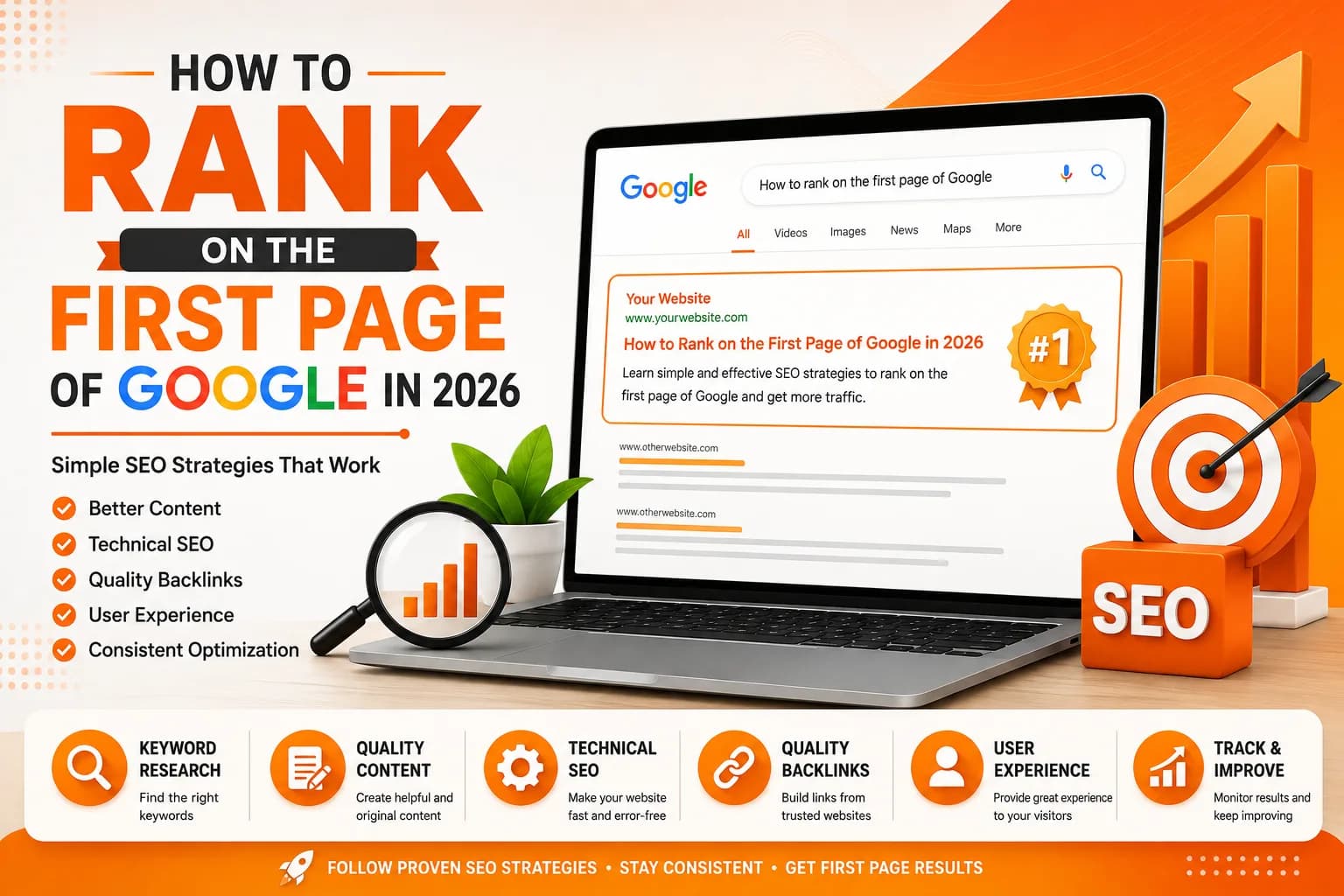
How to Rank on the First Page of Google in 2026

Harsh Rajput · Sr. SEO Executive · 3 years' experience · 11 August 2026 · Updated 7 September 2026 · 8 min read
Key takeaways
- Page one gets almost every single click.
- A few things changed.
- Before you write a single word, ask yourself what someone is typing this search for.
- Keywords still matter, just not the way they used to.
If your website is not on the first page of Google right now you are basically invisible. Sounds harsh but it is true. Nobody scrolls to page two anymore. I mean, when was the last time you clicked page 2 of a search result? Exactly.
The good part is ranking on page one is still very possible in 2026. It just does not work the way it used to work five years back. Google got smarter. AI overviews are everywhere now. Old tricks like stuffing keywords ten times in a paragraph just don't cut it anymore. So let's talk about what actually works right now.
Why page one is such a big deal
Page one gets almost every single click. Studies keep showing the same thing again and again, the top few results eat up most of the traffic and everything after that gets scraps. So if you're not there you're fighting for leftovers.
There's also a trust thing going on. People assume if Google put you on top you must know what you're doing. That trust is hard to build any other way, especially not with ads where people already know you paid to be there.
Google in 2026 is a different animal
A few things changed. Google now shows AI generated answers right at the top for a lot of searches, so people sometimes don't even click through anymore. Google also reads intent way better than before, it's not just matching words on a page to words in a search box.
What this means for you is simple. Write for humans first. Stop trying to trick an algorithm because honestly the algorithm has gotten too good at spotting that.
Step 1 - Figure out what people actually want
Before you write a single word, ask yourself what someone is typing this search for. Are they trying to buy something right now? Just researching? Comparing two options before deciding?
If your content doesn't match that intent you won't rank, doesn't matter how well written it is or how many times you use the keyword. This part gets skipped by a lot of people and it's honestly the most important step.
Step 2 - Keyword research, but smarter
Keywords still matter, just not the way they used to. Instead of chasing one single word, try to cover a topic properly from different angles. Long tail keywords (the longer, more specific phrases) are your friend here.
Something like "shoes" is basically impossible to rank for. But "best running shoes for flat feet" is much more winnable, and honestly the person searching that is way more likely to actually buy something.
Step 3 - Write content that actually helps
This is where most websites fail. They write thin, surface level stuff just to have "something" on the page. Google can tell. Go deep instead. Answer the real questions people have, not the surface level ones.
Keep your writing simple. Short paragraphs. Break it up with headings so people (and Google) can scan it easily, especially since most people are reading on their phone anyway.
One more thing - throw in your own take or experience where it fits. Google cares a lot about something called E-E-A-T (Experience, Expertise, Authority, Trust) especially for anything touching health, money or safety. Generic recycled content doesn't score well here anymore.
Step 4 - Get your on page SEO right
This part hasn't changed too much honestly, it's still the basics:
Keyword in your title, but written naturally
Mention it early in your first paragraph too
Use H1, H2, H3 properly to organize things
Write a meta description that actually makes someone want to click
Keep URLs short and clear
Add alt text on images
Link to your own related pages
Link out to good external sources when it makes sense
Don't force any of this. If it reads awkward, rewrite it.
Step 5 - Page speed and mobile matter more than you think
A slow website loses people before it even finishes loading. That's just a fact now, attention spans are short and getting shorter. Compress your images, clean up your code, use decent hosting.
And mobile - most of your traffic is coming from phones, not desktops. If your site looks broken or clunky on mobile you're losing rankings no matter how good your content is.
Step 6 - Backlinks still carry weight
A backlink is basically another site vouching for you. One link from a site people actually trust is worth more than fifty links from random spammy directories, so don't chase numbers, chase quality.
The best way to get these naturally is to make something worth linking to. Guest posts, outreach, actual relationships with other people in your space, all of that still works.
Step 7 - Don't sleep on technical SEO
Boring but important. Things like:
Clean sitemap
No broken links floating around
HTTPS everywhere
No duplicate content issues
Making sure Google isn't accidentally blocked from important pages
This stuff can quietly wreck your rankings even when your content is genuinely great. Worth a check every now and then.
Step 8 - Don't forget AI search
People aren't only searching the old fashioned way anymore, a lot of them are asking AI tools directly. So structure your content so it's easy to pull answers from - clear headings, direct answers up top, then more detail after. Helps humans skim it too honestly, it's not just for AI.
Step 9 - Old content needs love too
If you wrote something two years ago and haven't touched it since, go fix it up. Update facts, tighten the writing, add anything new that's relevant. Google notices when content is stale versus actively maintained, and this alone can bump rankings without writing anything brand new.
Step 10 - Keep checking, keep tweaking
SEO isn't something you do once and forget. Track your rankings, see what's working, and if something isn't moving after a few months go back in and improve it. Add more depth, fix the structure, get a few more links pointing at it.
It's kind of like maintaining anything really, ignore it and it slips.
Bottom line
Ranking on page one in 2026 really comes down to this - make something genuinely useful, keep your site fast and mobile friendly, build real trust over time, and don't ignore the technical stuff. None of this is instant. But stay consistent with it and page one is very much reachable.
Frequently Asked Questions
How to rank on first page of Google 2026?
Match your content precisely to what the searcher actually wants, cover the topic in genuine depth instead of surface-level points, fix technical basics like speed and mobile experience, earn a handful of credible backlinks, and structure the page so both readers and AI search tools can pull a direct answer from it. There's no single trick — it's intent-matching, depth, technical health, and trust signals working together.
How long does it take to rank on Google's first page in 2026?
Most pages take three to six months for lower-competition, long-tail keywords, and longer for competitive terms. Consistent publishing, solid on-page SEO, and early link building all shorten the timeline.
Can I rank without backlinks?
For very low-competition, specific long-tail keywords, yes — strong on-page SEO and genuinely comprehensive content can be enough. For anything moderately competitive, backlinks become one of the deciding factors.
Is E-E-A-T a direct Google ranking factor?
Not formally — Google has said it's a quality framework used by human raters, not a literal algorithm input. In practice, the signals behind it (real expertise, genuine experience, trustworthy sourcing) still influence rankings indirectly through content and authority quality.
Does content length matter for ranking?
Not as a fixed target. What matters is whether the page fully covers what the searcher needs. Longer content often ranks better simply because it tends to be more complete, not because word count itself is a ranking signal.
How is ranking for AI Overviews different from ranking on Google's page one?
They're related but not identical. Traditional ranking still matters — AI Overviews often pull from well-ranked organic pages — but content structured with clear, extractable, directly-stated answers has a better chance of being cited inside the AI summary itself.
Does social media activity affect Google rankings?
Not directly. It can help indirectly by driving traffic and increasing the chances content gets discovered and linked to by others, which does have a direct ranking effect.
Do I need to publish new content constantly to rank, or can I improve what I already have?
Both matter, but updating existing pages is often the faster win. Refreshing outdated stats, expanding thin sections, and fixing broken links on a page that's already indexed and carries some authority usually moves the needle quicker than starting a brand-new page from zero.
What's the difference between on-page SEO and technical SEO?
On-page SEO covers what's inside the content itself — title tags, headings, keyword placement, and internal links. Technical SEO covers the site's infrastructure — page speed, mobile-friendliness, indexing, and crawlability. A page can be perfectly written and still fail to rank if the technical layer underneath it is broken.
Can a brand-new website rank on page one of Google?
Yes, but realistically only for low-competition, long-tail keywords early on. A new site has no accumulated authority, so competing for broad, high-volume terms right away rarely works — narrower, more specific keywords are the practical starting point.
About the author
Sr. SEO Executive · 3 years' experience
Harsh Rajput is a Senior SEO Executive with 3+ years of experience in SEO, digital marketing and AEO/GEO strategy. He leads a team of SEO executives at Digisutra Solutions, handling keyword research, technical SEO, on-page/off-page optimization, link building and content strategy, while helping brands rank in Google AI Overviews and LLM platforms like ChatGPT, Claude and Gemini. He has worked with clients across India, USA, UAE, and Australia in industries like e-commerce, finance and technology.
Reader reviews
Up next · SEO & AI search · 20 min
Google Latest SEO Updates October 2026: What Changed and What to Do
Related · SEO & AI search · 36 min
How to Build Backlinks in 2026: 15 Safe Strategies That Still Work