

What Is Performance Marketing and How Does It Work?

Harsh Rajput · Sr. SEO Executive · 3 years' experience · 21 August 2026 · Updated 26 August 2026 · 6 min read
Key takeaways
- At its core, performance marketing comes down to one idea.
- The mechanics are simpler than most people think.
- No single platform owns performance marketing.
- Old advertising was a gamble.
Ask any business owner what bothers them most about advertising and you will hear the same thing. They spend money and have no clue if it actually worked. Performance marketing was built to fix exactly that problem. You pay for a click, a lead, a sale, or an install and nothing else. No guessing, no wasted spend on ads nobody clicked. This article breaks down what performance marketing really means, how the whole system works, and why more brands are switching to it every year.
What Is Performance Marketing
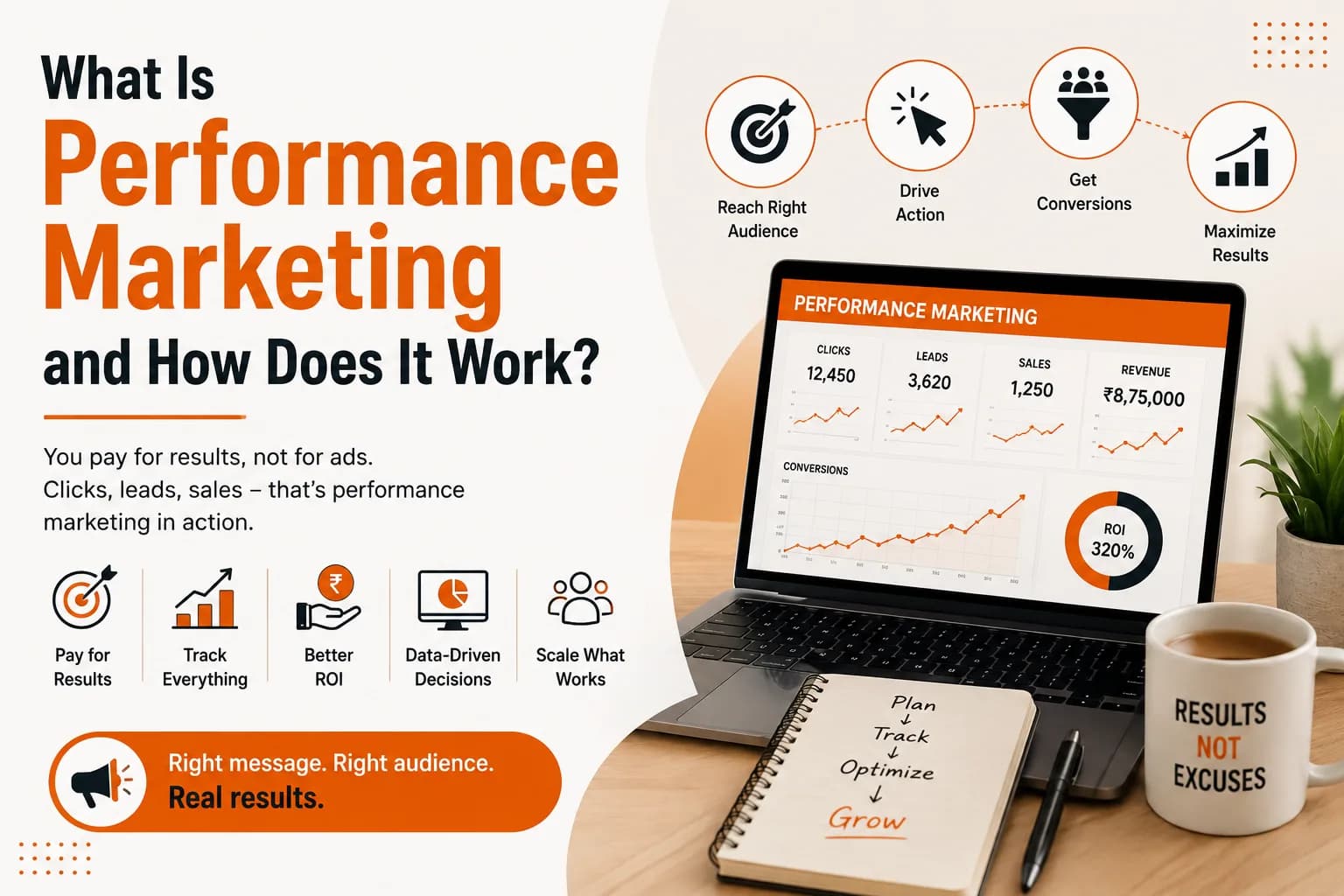
At its core, performance marketing comes down to one idea. You pay for results, not for exposure. A brand only spends money when someone clicks an ad, fills a form, buys a product, or installs an app. If nothing happens, the advertiser pays nothing or very little.
Compare that to old school advertising where a company pays a fixed amount for a billboard or a TV slot regardless of who actually sees it or acts on it. Performance marketing throws that model out.
Key traits of performance marketing
- You only pay when a real action happens
- Every rupee spent can be tracked back to a result
- Budgets shift fast based on live data
- Runs across search, social, display and affiliate networks
- Built around ROI, not just impressions
How Performance Marketing Actually Works
The mechanics are simpler than most people think. An ad goes out to a targeted audience, someone takes an action, and the advertiser pays for that specific action. What makes it powerful is everything happening behind the scenes. Tracking pixels, bidding algorithms, and constant testing keep sharpening the campaign as it runs.
A campaign never really "finishes." It just keeps getting refined week after week based on what the data shows.
Steps in a typical performance marketing campaign
1. Set a clear goal like leads, sales or installs
2. Pick the channel that fits your audience
3. Install tracking through pixels or conversion tags
4. Run a small test budget first
5. Check performance daily, not weekly
6. Adjust targeting, bids and creatives based on numbers
7. Push more budget once results hold steady
Common Channels Used in Performance Marketing
No single platform owns performance marketing. It spreads across search, social, affiliate and even email because people behave differently on each one. A shopper on Instagram is not in the same headspace as someone typing a query into Google.
Most agencies do not rely on one channel alone. They mix two or three together and let the data decide where to shift budget.
Popular performance marketing channels
- Search ads on Google for high intent buyers
- Social ads on Facebook, Instagram and LinkedIn
- Affiliate marketing where partners get paid on results
- Native ads blended inside content feeds
- Email sequences tied to conversion goals
- Influencer deals tracked through promo codes
Brands leaning heavily on Instagram or LinkedIn often bring in a dedicated social media marketing team so paid campaigns and organic content actually work together instead of competing for attention.
Why Businesses Are Choosing Performance Marketing
Old advertising was a gamble. You put money into a campaign and hoped people noticed. Performance marketing removes that guesswork because every rupee is tied to a measurable action.
It also levels the field for smaller businesses. A startup with a smart strategy can outperform a bigger competitor because success here comes down to execution, not just budget size.
Reasons businesses prefer this model
- Risk stays low since you pay for outcomes
- ROAS is easy to calculate and prove
- Test results come back fast
- Works for a five thousand rupee budget or a five lakh one
- Every decision backed by data, not opinion
Pairing this with solid SEO work usually pays off too since organic traffic keeps compounding while paid campaigns handle the short term wins.
Metrics That Matter in Performance Marketing
Numbers do the talking here. Skip the tracking and you are basically back to old school guessing. Every platform hands you a dashboard full of data but most of it is noise. A handful of metrics actually matter.
Good agencies strip out the clutter and build a simple report so clients can see what is working without staring at spreadsheets.
Metrics worth tracking closely
- Cost per click (CPC)
- Cost per acquisition (CPA)
- Return on ad spend (ROAS)
- Click through rate (CTR)
- Conversion rate
- Customer lifetime value
Performance Marketing vs Traditional Marketing
These two get mixed up constantly. Traditional marketing pays for reach. A magazine ad or a hoarding gets paid for regardless of who buys anything after seeing it. Performance marketing pays for the action itself.
Neither one is useless. Traditional marketing builds long term brand recall while performance marketing drives short term measurable growth. Most serious brands run both side by side.
Key differences to understand
- Traditional pays for exposure, performance pays for outcomes
- Traditional is hard to measure precisely, performance is not
- Traditional builds brand memory over years
- Performance drives sales and leads right now
- Traditional works well for mass awareness
- Performance works well for direct response
How to Build a Performance Marketing Strategy
Most failed campaigns fail for the same reason. No clear strategy before the ad spend started. Getting this right starts with knowing your audience cold and choosing platforms where they actually spend time instead of platforms that sound trendy.
Businesses that pair performance marketing with steady paid ads management tend to see results stabilize faster because someone is actively managing bids and creatives instead of setting it and forgetting it.
Steps to build your strategy
1. Nail down your ideal customer profile first
2. Choose channels based on where they actually hang out
3. Set a small test budget before scaling
4. Run three to four ad variations at once
5. Review numbers weekly and cut what is not working
6. Double down on whatever brings the lowest CPA
Conclusion
Performance marketing changed the rules of advertising by tying spend directly to results instead of hope. It gives businesses of every size a way to grow without burning cash on ads nobody responds to. Get the tracking right, pick the right channels, and keep testing — this model will keep paying for itself. As more platforms shift toward performance based pricing, this is quickly becoming the default way brands advertise online.
Frequently Asked Questions
What is performance marketing in simple words?
It is advertising where you pay only for a specific action like a click, a sale, or a lead instead of paying just to show the ad.
How is performance marketing different from digital marketing?
Digital marketing covers everything done online while performance marketing is one specific model inside it that focuses purely on paying for measurable results.
Which platforms are best for performance marketing?
Google Ads, Meta Ads and affiliate networks lead the pack because their tracking and targeting are the most reliable right now.
Is performance marketing good for small businesses?
Yes, because the risk is low. You control the budget and pay only when something actually happens, which protects cash flow.
How long does it take to see results from performance marketing?
Early data usually shows up within a few days. Real optimized results take about two to four weeks depending on the industry and how much budget is behind it.
About the author
Sr. SEO Executive · 3 years' experience
Harsh Rajput is a Senior SEO Executive with 3+ years of experience in SEO, digital marketing and AEO/GEO strategy. He leads a team of SEO executives at Digisutra Solutions, handling keyword research, technical SEO, on-page/off-page optimization, link building and content strategy, while helping brands rank in Google AI Overviews and LLM platforms like ChatGPT, Claude and Gemini. He has worked with clients across India, USA, UAE, and Australia in industries like e-commerce, finance and technology.
Reader reviews

Up next · Marketing & ads · 9 min
The Future of AI and Digital Marketing in 2026
Related · Marketing & ads · 5 min
How to Create a Content Marketing Strategy That Drives Results