

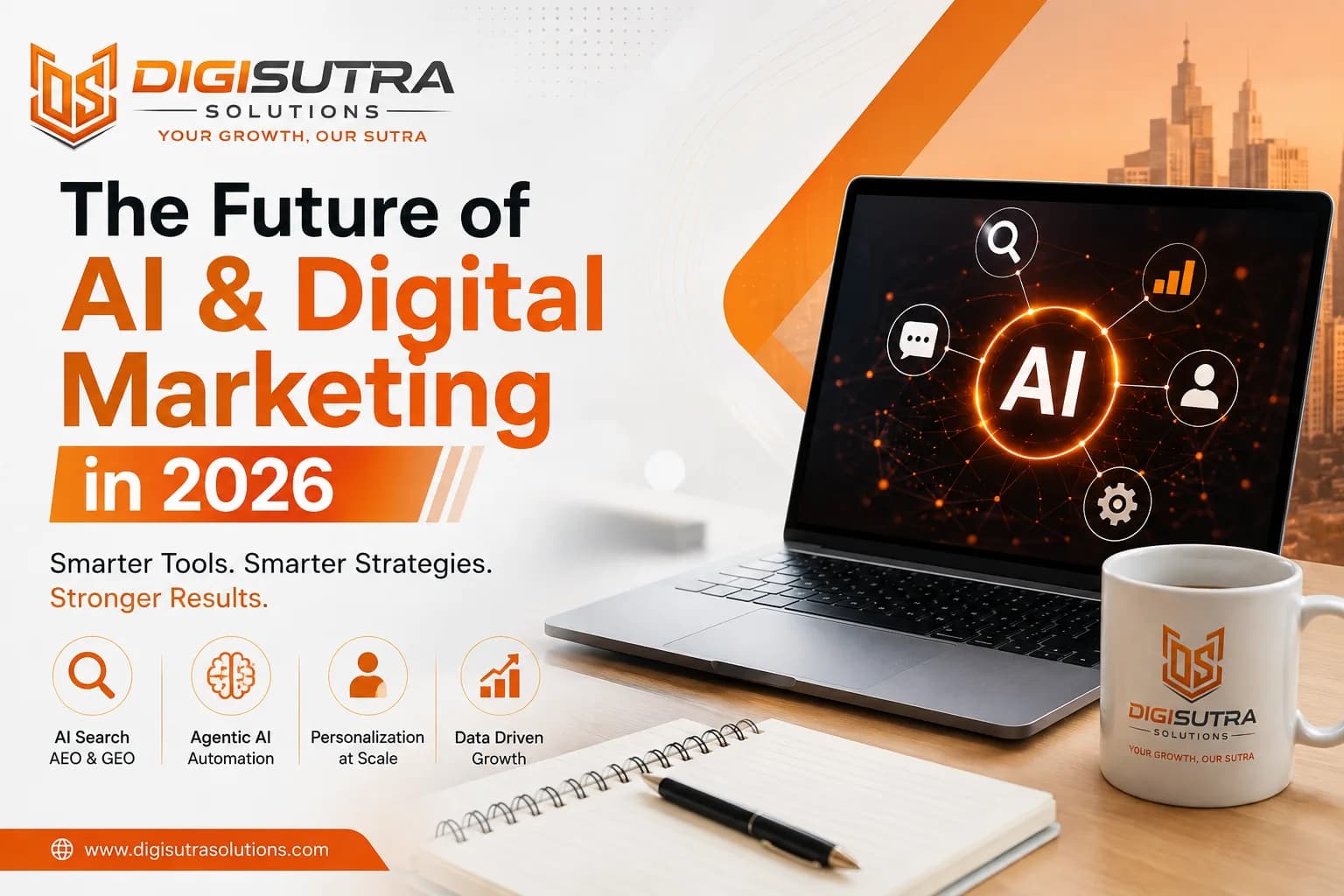
The Future of AI and Digital Marketing in 2026

Harsh Rajput · Sr. SEO Executive · 3 years' experience · 27 August 2026 · Updated 7 September 2026 · 9 min read
Key takeaways
- AI is no longer a side tool.
- Search Engine Optimization is not gone but it has a new partner.
- Most 2025 conversations about AI in marketing were about chatbots and content generation.
- The future of digital marketing 2026 is built around personalization at scale.
Digital marketing is changing fast and 2026 is shaping up to be a turning point. AI tools are now part of daily work for brands big and small. Search engines are showing AI summaries instead of plain blue links. Customers are asking chatbots for product advice instead of typing into Google. Marketers who adapt early are winning more visibility and more sales. This article breaks down what is really changing what brands need to do about it and where the AI hype is running ahead of actual results. We will cover AI search AEO GEO agentic AI content strategy automation and what smart marketing teams should focus on this year.
Why AI Is Reshaping Marketing in 2026
AI is no longer a side tool. It is now the engine behind search results content creation ad targeting and customer support. Brands that ignore this shift will lose ground quickly.
The future of AI 2026 is about visibility inside AI answers not just website rankings. Tools like ChatGPT Gemini and Perplexity are becoming research assistants for millions of people. If your brand does not show up in these answers you are invisible to a growing part of your audience.
What Changed in AI Marketing This Year
AI overviews now appear on most Google searches
LLM platforms like ChatGPT are used for product research
Voice and chat search queries are longer and more natural
Ad platforms use AI bidding instead of manual bidding
Content needs to answer questions directly not just rank for keywords
Agentic AI is moving from experiment to daily use inside larger companies
The Adoption Is Real But The ROI Gap Is not Closed Yet
Here is the part most articles skip. Adoption numbers look impressive on paper. Nearly nine in ten companies now use AI regularly in at least one part of the business, and large enterprises are scaling AI agents faster than ever. But when it comes to actual bottom line impact, the picture is more mixed. Only around a third of companies report AI meaningfully affecting their profit, and that share has barely moved year over year even as usage keeps climbing.
What does move the needle is how AI is used, not just whether it's used. Companies seeing real financial impact tend to redesign their workflows around AI instead of bolting AI onto old processes, and they invest more heavily in it. For agencies and marketing teams this is the real lesson for 2026. Buying AI tools is not a strategy. Rebuilding how work actually gets done around them is.
AEO and GEO Are the New SEO
Search Engine Optimization is not gone but it has a new partner. Answer Engine Optimization and Generative Engine Optimization are now just as important. These focus on getting your brand mentioned and quoted inside AI generated answers.
Ranking on page one is good. Being the source an AI model quotes is even better. This is where a solid content and technical setup makes the real difference. Businesses that want a structured approach to this shift often start with a proper SEO audit and strategy that maps both traditional rankings and AI answer visibility together, rather than treating them as separate projects.
How AEO and GEO Work in Practice
Write content that directly answers common questions
Use clear headings and short paragraphs AI can scan easily
Add structured data so search engines understand your content
Build authority through consistent publishing and backlinks
Keep information accurate since AI models avoid vague sources
Publish content with specific numbers and named sources, since generic trend statements get skipped over in favour of citable data
Agentic AI Is the Trend Marketers Can't Ignore Anymore
Most 2025 conversations about AI in marketing were about chatbots and content generation. Going into 2026 the bigger shift is agentic AI, meaning AI systems that don't just respond to prompts but take multi step actions on their own. Think AI agents that handle a customer's reorder end to end, or systems that manage ad bid adjustments and lead qualification without someone clicking through five dashboards.
Large companies are scaling this kind of automation much faster than smaller ones right now, mostly in areas like customer service, lead handling and campaign optimisation. For most businesses the practical move is not building your own AI agent from scratch. It is choosing the two or three repetitive processes eating the most team time (lead follow up, review responses, appointment reminders) and putting marketing automation around those first, before trying to automate everything at once.
The Future of Digital Marketing 2026 Is Personalized and Automated
The future of digital marketing 2026 is built around personalization at scale. AI lets brands create content and offers that feel personal without manual effort for every single customer.
Marketing teams now use automation to handle repetitive tasks. This frees up time for strategy and creative work. Chatbots email flows and ad campaigns can all run with less manual input while still feeling relevant to each person, and the biggest reported revenue gains from AI right now are actually coming from marketing and sales use cases specifically, ahead of most other business functions.
Key Shifts in Marketing Strategy for 2026
Hyper personalized email and ad content based on behavior
AI chat assistants handling customer questions instantly
Predictive analytics guiding budget decisions
Dynamic website content that changes per visitor
Marketing automation reducing manual reporting work
First-party and zero-party data becoming more valuable as third-party cookies fade further
Content Marketing Is Getting Smarter Not Shorter
There is a myth that AI means less content. The opposite is true. Brands need more content but it has to be sharper and more useful. Thin content built only for keywords is losing value fast.
Good content marketing now blends human expertise with AI efficiency. Writers use AI to research faster while adding real experience and original insight that AI cannot fake.
What Strong Content Looks Like in 2026
Real examples and data instead of generic statements
Clear structure with headings lists and short sections
Original opinions backed by experience
Regular updates to keep information fresh
Content built for both humans and AI crawlers
Brand trust signals, since AI platforms are increasingly weighing authority and authenticity alongside keyword relevance when picking which sources to quote
AI Automation Is Changing How Teams Work
Marketing teams are smaller but more productive because of automation. Tasks like reporting ad optimization and basic customer replies are handled by AI systems. This lets human teams focus on strategy creative direction and building real relationships with customers.
Businesses that invest in automation are seeing faster turnaround times and lower costs. This trend will only grow stronger through 2026 and beyond. It's worth being honest here too though. Not every team using AI automation is seeing productivity turn into profit yet, and mid-level staff report more AI-related friction (tool sprawl, unclear processes) than leadership does. The fix is usually less about adding more tools and more about picking one workflow and automating it properly end to end.
Areas Where Automation Is Making the Biggest Impact
Ad campaign optimization and bid adjustments
Lead qualification and CRM updates
Social media scheduling and basic replies
Email sequences triggered by user behavior
Reporting dashboards that update in real time
Brands looking to build a consistent voice across these automated touchpoints, especially on channels like Instagram, LinkedIn and Facebook, are also investing more in social media management so automation doesn't end up feeling robotic to the customer on the other end.
Local and Voice Search Are Growing Fast
More people are using voice assistants and local search to find businesses near them. This means marketing strategies need to include local SEO and conversational keywords. Long natural phrases are replacing short keyword typing.
Businesses that optimize their Google Business Profile and local content are capturing more of this traffic. This is especially important for service based businesses and local shops.
Local Search Priorities for 2026
Keep Google Business Profile updated with accurate details
Collect and respond to customer reviews regularly
Use natural language in local landing pages
Target question based local keywords
Ensure fast mobile friendly website performance
What Brands Should Do Right Now
Waiting is not a strategy. Brands that start adapting now will have a strong lead by the end of 2026. The gap between AI ready brands and traditional ones is growing every month, and the gap between brands that just use AI tools versus brands that redesign their workflows around AI is growing even faster.
Action Steps for Marketing Teams
Audit your website for AI search readiness
Update old content to answer real customer questions
Add structured data and clear formatting site wide
Start testing AI automation for one high-friction workflow before scaling to more
Track visibility inside AI platforms not just Google rankings
Set a real measurement point for AI ROI so you know if it's working, not just if it's being used
Conclusion
AI and digital marketing are moving together in 2026 and there is no separating them anymore. Brands need to think beyond traditional rankings and focus on visibility across search engines AI platforms and local results. Content still matters a lot but it needs to be sharper more useful and built for both humans and machines. Automation is freeing up time so teams can focus on strategy and real customer connection, though the businesses actually converting that time savings into revenue are still the minority right now. The businesses that adapt early, measure honestly, and rebuild their workflows around AI rather than bolting it on will capture more attention more leads and more sales this year.
FAQ
What is the future of AI in digital marketing for 2026?
AI will power search results, content creation and customer interactions more than ever, with agentic AI handling more multi-step tasks on its own. Brands need to focus on AI search visibility along with traditional SEO to stay competitive, while also tracking whether AI use is actually translating into revenue.
What is AEO and why does it matter in 2026?
AEO stands for Answer Engine Optimization. It focuses on getting your content quoted and used inside AI generated answers on platforms like ChatGPT and Google AI Overviews.
What is agentic AI and how is it different from a chatbot?
Agentic AI refers to AI systems that take multi-step actions on their own, like handling a customer reorder or adjusting ad bids, instead of just responding to a single prompt like a chatbot does.
Will AI replace human marketers?
No. AI handles repetitive tasks and research faster but human marketers are still needed for strategy creativity and building real customer relationships. Current data also shows AI is improving individual productivity far more consistently than it's improving company-wide profit, which is exactly where human judgment still matters.
How can small businesses prepare for AI driven marketing?
Small businesses should focus on clear website content, accurate local listings, and automating just one repetitive workflow well rather than several half-built ones. These steps do not require a huge budget but make a real difference.
Is content marketing still important with AI search growing?
Yes content marketing is more important than ever. AI platforms need clear accurate and well structured content to pull answers from, and they favour sources with specific data over vague claims. Weak or generic content simply gets ignored.
About the author
Sr. SEO Executive · 3 years' experience
Harsh Rajput is a Senior SEO Executive with 3+ years of experience in SEO, digital marketing and AEO/GEO strategy. He leads a team of SEO executives at Digisutra Solutions, handling keyword research, technical SEO, on-page/off-page optimization, link building and content strategy, while helping brands rank in Google AI Overviews and LLM platforms like ChatGPT, Claude and Gemini. He has worked with clients across India, USA, UAE, and Australia in industries like e-commerce, finance and technology.
Reader reviews
Up next · AI automation · 20 min
AI Project Planning: How to Scope an AI Project Before Writing Code
Related · SEO & AI search · 20 min
Google Latest SEO Updates October 2026: What Changed and What to Do