
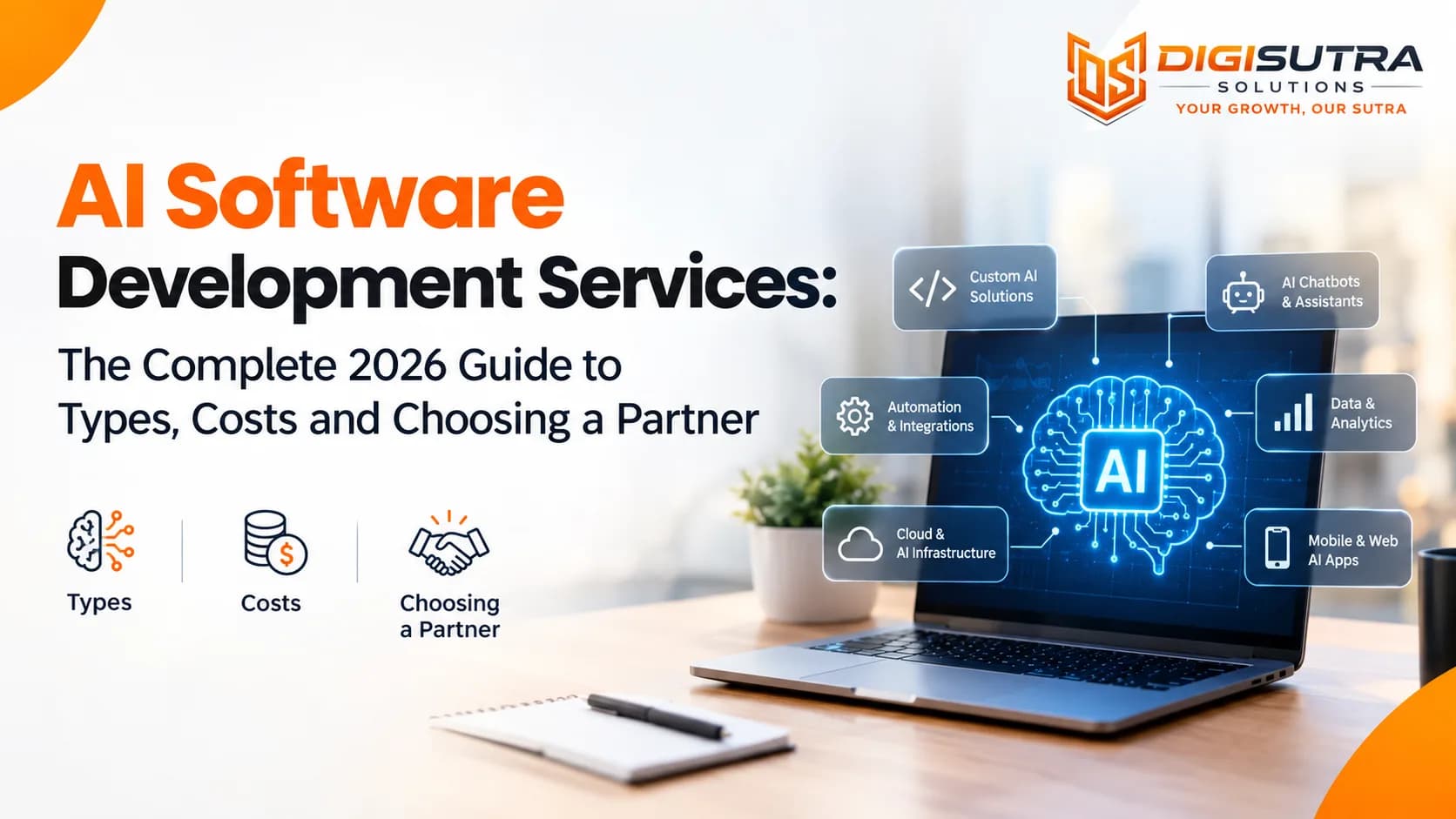
AI Software Development Services: The Complete 2026 Guide to Types, Costs and Choosing a Partner
Key takeaways
- AI software development services are the planning, building, testing and support work that turns an AI idea into working software.
- Providers group their work into a handful of service types.
- An AI agent is software that plans steps and uses your tools to finish a task.
- A ready-made tool works for common tasks like drafting emails.
Every business wants AI right now. Very few know where to start. Some buy a chatbot subscription and wait for results. Others hire a team and end up with a demo that never reaches real work.
AI software development means building software that learns from data and then answers questions or takes actions on its own. It replies to customers. It sorts leads. It reads documents. It forecasts demand. The same phrase also covers using AI tools to build normal software faster. This guide explains both.
You will see what AI software development services include and what they cost. You will also see how a project runs step by step and how to pick the right partner. Each section opens with a short answer so you can scan fast.
Key Takeaways
AI software development services cover strategy, build, integration, security and support for AI that runs on your own data
Start with one costly task and one number that proves success
Pick the lightest method that works: prompt setup, then RAG, then fine-tuning, then a custom model
Published agency prices run from about $6,000 to $500,000+ and lean builds can start under $1,000
Ask for a proof of concept and live references and written data ownership before you sign
What Are AI Software Development Services?
AI software development services are the planning, building, testing and support work that turns an AI idea into working software. A provider studies your problem and prepares your data. Then they pick the right AI model and connect it to your tools. You end up with a system your team uses every day.
Good AI software development services start with a business problem and not with a model. The model is only the engine. The value comes from your data and your rules and the way the system fits into daily work.
Three terms get mixed up so here is the plain version. Artificial intelligence is the wide field of machines doing tasks that need human thinking. Machine learning is the part where software learns patterns from data. Generative AI is the part that creates new text and images and code.
What a Full Service Usually Includes
AI strategy and readiness check
Use case selection and success metrics
Data review and cleanup
Model choice and prompt design
Software build and tool integration
Testing with real business scenarios
Launch support and monitoring
Team training after handover
AI Software Development vs AI-Assisted Software Development
The phrase has two meanings and providers sell both. One builds AI into your product. The other uses AI tools to build any software faster.
Feature | AI software development | AI-assisted software development |
Goal | The AI feature is the product | Faster delivery of any software |
Examples | RAG assistant, agent or vision model | Code generation, auto test cases and smarter release pipelines |
Main benefit | Better service and faster operations | Shorter build time and fewer defects |
Main risk | Wrong answers and data leaks | Unreviewed code and security gaps |
Speed claims need a pinch of salt. A 2025 METR study found that experienced open source developers took 19% longer with early 2025 AI tools even though they felt faster. Review AI-written code the way you review a new hire's code.
Types of AI Software Development Services
Providers group their work into a handful of service types. Most businesses begin with one and add more once the first system proves its worth.
AI agents are the fastest growing type. An agent plans steps and acts across your tools. It can tag a lead, update the CRM and send a follow-up message without a person touching it. Teams that want this kind of workflow often pair it with AI automation for WhatsApp, CRM and email.
Common Service Types
AI strategy and readiness consulting
Custom chatbots and virtual assistants trained on your own content
Knowledge assistants that answer from your internal documents
AI agents that take actions across your software
Predictive models for demand, churn and risk
Computer vision and OCR for image checks and document scanning
Generative AI features inside your website or app
Voice AI for calls and speech to text
AI integration into software you already run
MLOps for monitoring and retraining after launch
AI Agents and Agentic AI: What Businesses Should Know
An AI agent is software that plans steps and uses your tools to finish a task. A chatbot answers a question. An agent does the work behind it. Multi-agent systems let several agents share a job such as one reading an invoice and another checking it against an order.
Agents need more care than chatbots because they can change real records. Many teams connect agents to CRM, ticketing and file tools through standard connectors such as MCP. Each connector should have its own permission level and its own log.
Four Levels of AI Autonomy
Answers only with no action taken
Suggests an action and a person does it
Acts after a person approves
Acts alone on low-risk tasks
Guardrails Every Agent Needs
Least access so the agent only touches what the task needs
Human approval for refunds, payments and deletions
A full log of every action
A test set that runs before each update
A clear handoff to a person when confidence is low
Gartner predicted in June 2025 that over 40% of agentic AI projects will be canceled by the end of 2027 because of rising cost and unclear value and weak risk control. Start with level 2 or 3 and move up only after the numbers hold.
Custom AI vs Ready-Made AI Tools
A ready-made tool works for common tasks like drafting emails. Custom AI works when your process has rules that no template can handle. The tool adjusts to you instead of the other way round.
Generic tools stall fast. They give vague answers on your pricing and policies because they never saw your data. Research backs this up. An MIT NANDA study from 2025 found that around 95% of generative AI pilots stalled without a clear effect on profit. The main reason was poor fit with how each business works.
Before you commit to a build you can sketch the conversation flow yourself. A free AI chatbot builder helps you map questions and answers on paper first.
When to Build Custom and When to Buy
Build custom when the AI must read private data like orders or contracts
Build custom when it has to work inside your CRM, website or WhatsApp
Build custom when privacy rules limit where your data can go
Buy a ready-made tool when the task is common and the stakes are low
Buy a ready-made tool when you are still testing if AI helps at all
Generative AI or Traditional Machine Learning?
Use generative AI when the output is text or images or when people talk to the system in plain language. Use traditional machine learning when you need steady and measurable outputs like forecasts and scores and fraud flags. Many strong systems use both. Generative AI handles the messy input and machine learning handles the prediction.
Core Technologies Behind AI Software
You do not need to master the tech but a few terms help you read a proposal. Most modern systems use several of these together.
Large language models power assistants and writing tools. Retrieval augmented generation (RAG) lets the AI look up facts in your own files before it replies. That one step cuts wrong answers a lot because the AI quotes your documents and not a guess.
Key Terms in Plain Words
Large language models (LLMs): Models like GPT, Claude and Gemini that read and write text
Small language models (SLMs): Compact models tuned for one repeated task that cost less per request
RAG: A method that fetches your own data before the AI answers
Vector database: A store that turns your content into searchable numbers so RAG finds the right passage
Machine learning: Pattern finding on past data to predict what comes next
Natural language processing: Reading and writing human language in chats and emails
Computer vision: Understanding images and video
AI agents: Systems that plan steps and use tools to finish a task
Fine-tuning: Extra training on your examples so the model learns your tone and terms
Prompting vs RAG vs Fine-Tuning vs Custom Model
Pick the lightest method that solves the problem. Starting from an existing model and adding your data is faster and cheaper in most cases.
Method | Use it when | Effort | Example |
Prompt setup | The task is common and rules are short | Days | Draft replies in your brand tone |
RAG | Answers must come from your documents | Weeks | Policy and product Q&A assistant |
Fine-tuning | You need a fixed style or niche terms at scale | Weeks to months | Formatting claim notes the same way every time |
Custom model | The task is unique and your data is large | Months | Fraud scoring or defect detection |
How the AI Software Development Process Works
A good project does not begin with code. It begins with one clear problem and a number that shows success. Skipping that step is the top reason AI projects fail.
Data prep comes next and it trips up many teams. Messy spreadsheets with duplicates and empty rows give messy answers. A quick pass through a free CSV cleaner fixes the basics before any build starts. For RAG the files also need clear owners, current versions and access rules.
The build also needs a solid front end. If your AI feature lives on a slow or confusing site people leave before they try it. That is where strong website design and development supports the whole project.
The Typical Build Steps
Define the problem and pick one success metric
Check readiness of data, tools and people
Review the data you already have
Choose the model or mix of models
Build a small proof of concept with real data
Build the full system and connect your tools
Test with real cases and not demo questions
Launch to a small group first
Refine based on actual usage
Keep monitoring accuracy as your data changes
What a Good Proof of Concept Should Prove
Your data can be reached and prepared in a safe way
Answers hit your accuracy target on real questions
Integrations and permissions work as planned
The result beats your current process on the same task
The cost per request fits your budget
Quick Readiness Check
One problem you can state in a single sentence
One person who owns the result
One data source that is digital and reachable
One number that proves success
One human fallback for cases the AI cannot handle
If you can tick all five you are ready for a pilot.
How Long Each Stage Takes
Discovery takes a few days to two weeks
A proof of concept takes one to four weeks
The full build takes two to eight weeks for most small and mid-size projects
Testing and a staged launch take one to two weeks
Adding AI to Software You Already Run
You do not need to replace your systems to use AI. Most good projects plug AI into the tools your team already uses so people get answers inside their normal screens.
Lead and customer data is the usual starting point. An AI layer on top of a CRM and lead management system can score leads and draft follow-ups and flag deals that are going cold.
Where AI Plugs In
CRM and sales tools: Lead scoring, call summaries and next-step tips
Website and chat: Support assistants and smart search
Ecommerce stores: Product suggestions and order tracking and returns help
Mobile apps: Personal feeds and voice or chat features
Documents and databases: Search and summaries over files you already hold
Cloud setup: AI that runs inside the cloud account you already pay for
When You Already Have an AI System
A pilot worked for one team and will not scale
A prototype was never built for real traffic
An LLM app gives answers nobody trusts
An old ML model runs on tools that are falling behind
A good provider can audit what exists and fix the weak part before suggesting a rebuild.
Where Businesses Use AI Software Today
AI software pays off where work is repetitive, data heavy and time sensitive. Support, sales and operations see results first.
A support assistant is a good example. Picture a store with 300 customer messages a day. Most ask about order status and returns. An AI assistant connected to the order system answers those in seconds and hands refunds to a person. Many teams start here with AI-powered customer support.
Marketing teams use the same tech for content and ad analysis. Our post on how AI is transforming digital marketing in 2026 shows where that shift is heading.
Use Cases by Industry
Healthcare: Patient intake and triage chat and appointment booking with strict privacy controls
Finance and insurance: Fraud alerts, document checks and claims sorting
Banking: Faster KYC checks and loan support and compliance monitoring
Ecommerce and retail: Product suggestions, demand forecasts and order tracking on WhatsApp
Manufacturing: Defect detection and predictive maintenance
Logistics: Route planning and delivery updates and warehouse forecasts
Real estate: Lead qualification, property matching and lease reading
Education: Student query assistants and adaptive lessons
Legal and HR: Contract review and CV screening support and onboarding help
How Much Do AI Software Development Services Cost?
Cost depends on scope and not on the word AI. A simple chatbot on one data source costs far less than a platform that touches five tools and makes decisions. Focused builds at Digisutra Solutions start around $860 (about ₹87,000) and most go live in 2 to 6 weeks. Many other agencies publish higher starting prices. The table shows rounded ranges from public agency pricing pages in 2026.
Project type | Published market range | Typical timeline |
Focused chatbot or single-tool automation | About $6,000 to $30,000 | 2 to 8 weeks |
Knowledge assistant with RAG | About $10,000 to $100,000 | 4 to 12 weeks |
AI agent connected to several systems | About $50,000 to $150,000+ | 2 to 5 months |
Enterprise platform with many AI parts | About $100,000 to $500,000+ | 5 to 11 months |
Plan for running costs too. Model providers charge per request and hosting and monitoring never stop. Before you sign anything test the numbers with a free ROI calculator so you know the break-even point.
What Changes the Price
How many systems the AI connects with
Whether it only answers or also takes actions
How much data needs cleaning first
How much testing the use case needs
Privacy rules like GDPR, HIPAA and India's DPDP Act
The level of customization from prompt setup to a fully custom model
Voice or image input which costs more than text
Ongoing Costs to Budget For
Model usage fees per request
Hosting and databases
Monitoring and bug fixes
Knowledge updates and retraining
New features as your needs grow
Engagement Models for AI Projects
Providers offer a few ways to work together. The right one depends on how clear your scope is.
Common Models
Project-based: Fixed scope and milestones for one defined system
Dedicated team: A set group of AI engineers who work as an extension of your team
Managed service: The provider monitors and maintains the system after launch
Advisory: Short strategy and readiness work before you commit to a build
Many businesses start with advisory or a small proof of concept and then move to a project-based build.
How to Choose an AI Software Development Partner
For most small and mid-size businesses a partner is faster and cheaper than an in-house team. The same MIT research found that projects built with specialist partners succeeded about 67% of the time. Fully in-house builds did far worse.
A good partner asks about your workflow before they talk about tools. A weak one opens with buzzwords and sends a proposal on day one.
Six Steps to Pick a Partner
Write down your problem, budget and deadline
Shortlist teams with work in your industry
Ask to see live systems and talk to real clients
Meet the people who will actually build it
Pay for a small proof of concept before the full build
Put scope, ownership and reporting in the contract
Questions to Ask Before You Sign
Can you show live systems in daily use and not only demos?
Do you have past work in my industry?
Who owns the code, the data and the prompts after handover?
What does it cost to run and maintain the system each month?
Will you train my team?
How do you test accuracy before launch?
Certifications Worth Asking About
ISO/IEC 27001 for information security
A current SOC 2 Type II report for sensitive or enterprise data
ISO/IEC 42001 for AI management where available
For health data a provider should follow HIPAA safeguards and sign a Business Associate Agreement because no official HIPAA certification exists
Red Flags
A promise of 100% accuracy
Pricing nobody can explain in plain words
The same tool pitched for every problem
No plan for support after launch
Vague answers about data security
Security, Privacy and Responsible AI
An AI system often sees customer names, orders and health details. Security has to be planned from day one and not added at the end.
AI adds its own risks on top of normal software risks. A prompt injection is a trick where hidden text in a file or web page tells the AI to break its rules. A hallucination is a confident wrong answer. Both need testing before launch and checks after it.
Security Checklist
Know where your data is stored and who can reach it
Confirm your data is not used to train public models
Use role-based access so staff only see what they need
Limit what the AI can retrieve to what the user may already see
Test for prompt injection and unsafe outputs before launch
Keep a human in the loop for refunds, loans and medical advice
Log what the AI says and does
Get written proof that you own the code and the data
Rules and Standards That May Apply
GDPR: Personal data of people in Europe
HIPAA: Health data in the United States
India's DPDP Act: Personal data in India
EU AI Act: Risk rules for AI sold or used in the EU
NIST AI Risk Management Framework: A voluntary US guide for managing AI risk
SOC 2 and ISO 27001: Proof of security controls at the provider
How to Cut Wrong Answers
Ground answers in your own documents with RAG
Limit replies to set formats and allowed actions
Run a fixed test set after every change
Add human review where mistakes cost money
After Launch: Monitoring, MLOps and Support
Launch is not the finish line. Models drift as your products and customers change. A system that scored well in month one can slip by month six if nobody watches it.
MLOps is the set of habits that keeps AI healthy in production. It covers tracking accuracy, spotting drift, retraining and rolling back a bad update. Ongoing website maintenance and security keeps the app and its integrations patched and healthy long after go-live.
What to Monitor
Answer accuracy on a fixed test set
Share of chats that needed a person
Response time and cost per request
Drift when new products or policies appear
Security alerts and failed actions
How to Measure ROI From AI Software
Pick one number before the build starts and compare it after launch. The simple formula is value gained minus total cost then divided by total cost and multiplied by 100.
Early wins often come from the back office. The MIT NANDA research found that back-office automation gave some of the strongest returns even though most budgets went to sales and marketing tools.
A free marketing KPI dashboard shows cost per lead and conversion changes before and after your AI goes live.
Metrics Worth Tracking
Staff hours saved each week
Average reply time
Share of queries solved without a person
Lead response time and conversion rate
Error rate on tasks like data entry
Cost per ticket or order
Customer satisfaction score
AI Software Development Services for India, the USA and Dubai
Buyers in each region care about different things. Data rules, support hours and price decide most choices.
Digisutra Solutions works from Noida and serves clients in 12+ countries. India and Dubai share almost the same working day so calls and reviews are easy to schedule. US clients need a planned overlap window of a few hours each day.
What Changes by Region
India: DPDP Act rules for personal data and a deep pool of engineers
USA: HIPAA and SOC 2 expectations for health and finance projects
Dubai and the UAE: Local data protection law and strong demand for Arabic and English assistants
Common Mistakes in AI Projects
Most AI projects fail because of planning and not because of technology. A team that treats AI like a magic fix ends up with a tool nobody uses.
Mistakes to Avoid
Starting with the tool and not the problem
Feeding the AI messy or outdated data
Skipping the pilot and launching to everyone
Trying to automate every process in one project
Setting no success metric before the build
Ignoring how the team will actually use the system
Forgetting to retrain as data changes
Giving the AI access to files that users should not see
Letting agents act on live records with no approval step
Conclusion
AI software works best when it fits your business. Start with one costly task and one person who owns the result. Use your own data and measure one number before and after launch.
Small focused builds beat big plans. Prove the first system and then expand. Choose a partner who asks hard questions and shows live work and hands you full ownership. That path keeps cost low and results real.
Frequently Asked Questions
What are AI software development services?
They are services that plan and build software powered by AI and then keep it running. The work covers strategy, data prep, model selection, integration, testing and support. The goal is a system that solves one business problem using your own data.
How much do AI software development services cost?
Published agency ranges start near $6,000 for a focused chatbot and reach $100,000 to $500,000+ for enterprise platforms. Lean builds on existing models can start under $1,000 at agencies like Digisutra Solutions. Scope, integrations and data quality drive most of the price.
How long does it take to build an AI application?
Focused projects take 2 to 8 weeks. Knowledge assistants take 4 to 12 weeks. Agents that connect several systems take 2 to 5 months. Enterprise platforms and custom models can take 5 to 11 months. A proof of concept usually takes 1 to 4 weeks.
What is the difference between custom AI and tools like ChatGPT?
ChatGPT is a general tool made for everyone. A custom system often uses similar models underneath but connects them to your private data, rules and software. You also control access, logging and how it runs.
Should I use generative AI or traditional machine learning?
Use generative AI for text and images and natural conversation. Use traditional machine learning for forecasts, scores and fraud detection. Many projects combine both so generative AI handles messy input and machine learning makes the prediction.
What is the difference between AI software development and AI-assisted software development?
AI software development builds AI into the product such as an assistant or agent. AI-assisted software development uses AI tools to write and test normal software faster. Providers often sell both so ask which one a proposal covers.
What data do I need to start?
You need documents and records tied to one task. Product details, policies and past chats are often enough. For RAG the files should be current and have clear owners and access rules. You do not need millions of records.
How do you stop an AI from giving wrong answers?
Ground answers in your own documents with RAG and limit what the AI may say or do. Run a fixed test set after each change. Add human review for high-risk tasks. Monitor accuracy after launch because answers can drift over time.
Should I hire an agency or build an in-house team?
An agency is usually faster and cheaper for a first project. An in-house team makes sense when AI is the product you sell or when you plan many projects over several years. Many businesses start with a partner and train their own staff later.
How do I keep my data safe and stay compliant?
Ask where data is stored and who can see it. Confirm it is not used to train public models. Use role-based access and logs. Check for ISO 27001 and SOC 2 Type II. For health data ask about HIPAA safeguards because no official HIPAA certification exists.
About the author

Sr. SEO Executive · 3 years' experience
Harsh Rajput is a Senior SEO Executive with 3+ years of experience in SEO, digital marketing and AEO/GEO strategy. He leads a team of SEO executives at Digisutra Solutions, handling keyword research, technical SEO, on-page/off-page optimization, link building and content strategy, while helping brands rank in Google AI Overviews and LLM platforms like ChatGPT, Claude and Gemini. He has worked with clients across India, USA, UAE, and Australia in industries like e-commerce, finance and technology.
Reader reviews
Up next · AI automation · 19 min
AI Automation Services for Small Businesses: Types, Costs and How to Start
Related · Marketing & ads · 15 min
Performance Marketing Services in India: How to Set Goals, Budgets and KPIs That Guide Spend