

Why Your Website Is Not Ranking on Google and How to Fix It

Harsh Rajput · Sr. SEO Executive · 3 years' experience · 12 August 2026 · Updated 29 September 2026 · 8 min read
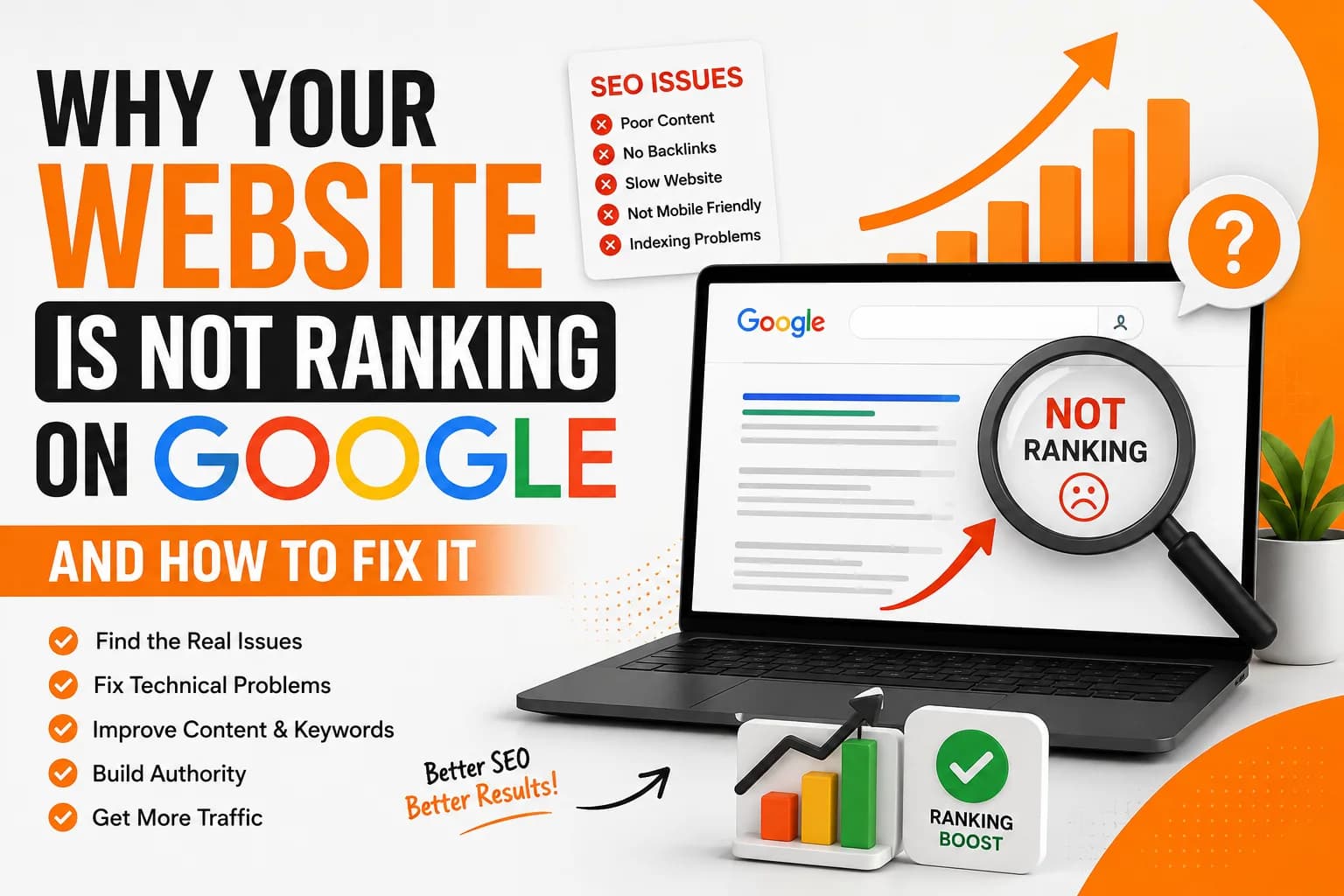
Key takeaways
- Google does not extend trust the moment a site goes live.
- We still see a lot of service pages built around 150 to 250 words, basically placeholder text with a contact form underneath.
- There's often a gap between how a business describes itself and how customers actually search.
- Somewhere around the two to three second mark, a meaningful share of visitors give up before a page even finishes loading.
A client came to us a while back convinced their SEO was broken. Their website was two years old, decent design and a handful of blog posts. Traffic was flat. When we pulled it apart, there wasn't one big problem. There were six small ones, stacked on top of each other, each one quietly cancelling out whatever the others were doing right. That's the pattern we see most often. Not ranking on Google is rarely one mistake. It's usually a combination, and once you know what to check, most of it is fixable.
Here are the most common reasons a website fails to rank, and what actually helps with each one.
1. Your Website May Simply Be Too New
Google does not extend trust the moment a site goes live. It watches for a while first.
What Google Is Actually Watching For
Are you publishing content consistently, or did the site go quiet after launch
Do visitors stay and read, or bounce straight back to the search results
Does the domain behave like a real, ongoing business rather than something thrown together and abandoned
How Long This Usually Takes
This evaluation period usually runs three to six months, sometimes longer in competitive industries. A regional accounting firm might see traction faster than a company trying to break into a saturated space like personal injury law, where every competitor has been building authority for a decade.
2. Thin Pages Don't Hold Up Anymore
We still see a lot of service pages built around 150 to 250 words, basically placeholder text with a contact form underneath. If someone searches "how much does a kitchen remodel cost" and lands on a page that says almost nothing about cost, they're back on Google within seconds.
What a Page That Actually Holds Up Looks Like
A clear, direct answer to the question in the search query
Real specifics, numbers, examples, steps, not vague statements
Enough depth that the reader doesn't need to open a second tab to get the full picture
3. You May Be Targeting the Wrong Keywords
There's often a gap between how a business describes itself and how customers actually search.
An Example of the Gap
A dental practice might describe itself as offering "comprehensive family dental care," while actual search volume sits almost entirely on things like:
Emergency dentist near me
Tooth pain same day appointment
Cost of a dental crown
How to Find the Real Keywords
Pulling real search data, through a keyword tool or even just watching Google's autocomplete, usually reveals this gap fast, and it's often bigger than expected.
4. Site Speed Is Losing You Visitors Before They Even Read Anything
Somewhere around the two to three second mark, a meaningful share of visitors give up before a page even finishes loading.
The Usual Culprits
Uncompressed images, often several megabytes each when they should be under 200 kilobytes
Old plugins or scripts nobody remembers installing, still running in the background
A hosting plan that was fine for a small brochure site but can't keep up now
How to Check It
A free speed testing tool will usually surface this within a minute or two, even if the site "feels fine" on office wifi.
5. Mobile Experience Gets Overlooked More Than It Should
Open your own website on a phone right now, not a tablet, an actual phone screen.
What to Check On Mobile
Is the text legible without zooming in
Are buttons and tap targets spaced far enough apart
Does anything overlap, cut off, or require horizontal scrolling
Why It Matters So Much
More than half of search traffic today comes from mobile devices. A clunky mobile experience shows up in user behavior first, and eventually in rankings too.
6. Backlinks Are Still One of the Bigger Factors
A backlink is essentially another website vouching for yours. When a number of credible sites link to a page, Google treats that as evidence the content carries some weight.
Ways to Build Backlinks Over Time
Guest posts on relevant, reputable sites in your industry
Genuine partnerships with businesses that serve a similar audience
Content solid enough, a guide, original research, a useful tool, that other sites choose to reference it on their own
There's no real shortcut here. It takes time, but it compounds.
7. Technical Issues Hide in Places Owners Rarely Check
Sometimes none of the above is the actual problem. It's something quieter.
Common Technical Issues We Find
A broken or missing sitemap
A robots.txt file accidentally blocking Google from crawling half the site
Internal links pointing to pages that no longer exist
Duplicate pages competing against each other for the same keyword
These tend to go unnoticed for months because nothing about them is visible on the surface. A basic technical audit often turns up two or three things like this.
8. Local Businesses Often Skip an Easy Win
For a business serving a local area, the Google Business Profile carries real weight.
What to Check On Your Profile
Is the profile fully filled out, hours, address, categories, photos
Are recent reviews coming in, or is the last one from two years ago
Is the business responding to reviews, even briefly
We regularly see profiles set up once and never touched again. Updating it and asking recent customers for a review is one of the lower effort, higher impact fixes available.
9. Sometimes the Competitor Is Just Working Harder
There's no way to soften this one. In some cases, the honest answer is that a competitor publishes more often, has a faster site, and has spent years building backlinks and trust that a newer site hasn't built yet. That's not a reason to stop. It just means the timeline for closing the gap is longer than a few weeks.
10. Where to Start, In Order
Test site speed and fix the obvious issues first, it's quick and often the biggest early win
Check the mobile experience directly on an actual phone
Go through existing pages and rewrite the ones that don't fully answer the visitor's question
Pull real keyword data and match the language customers actually search
Have someone check for broken links, crawl errors, and a missing or outdated sitemap
If the business is local, get the Google Business Profile fully filled out and current
Start building backlinks gradually through legitimate outreach and genuinely useful content
None of this is a one-time task. Rankings respond to sustained effort over months, not a single afternoon of changes.
Final Thoughts
A website not ranking on Google usually isn't broken in one dramatic way. It's more often a handful of smaller issues, each one modest on its own, adding up to a real problem together. Some of these are quick to fix, an image compressed, a headline rewritten. Others take longer, particularly backlinks and the kind of trust that only builds over time. Working through them one at a time, in order, is what actually moves a site toward page one.
Common Questions
Why is my website not showing up on Google at all?
The most likely reason is an indexing problem, not a ranking one. Check the exact URL in Google Search Console's inspection tool before assuming it's a content issue.
How long does it take for SEO fixes to show results?
Technical fixes can move within two to four weeks. Content changes to existing pages usually take six to twelve weeks. New content on a competitive keyword can take three to six months to fully settle.
Do backlinks still matter for ranking in 2026?
Yes. They remain one of the strongest authority signals Google uses, though relevance and quality now matter far more than the total count.
Can two pages on my own site hurt each other's rankings?
Yes, this is called keyword cannibalization. When two pages target the same term, Google splits authority between them and often ranks neither as well as one combined page would.
Does site speed really affect Google rankings?
Yes. Speed is one of the factors in Google's page experience signals, and slow pages also lose visitors before they finish loading, which shows up as poor engagement Google can measure separately.
Is a mobile friendly design necessary for SEO?
Yes. Google indexes and ranks based on the mobile version of your site first, so a mobile experience with legible text and workable navigation isn't optional anymore.
How many backlinks does a website need to rank well?
There's no fixed number. What matters more is relevance and quality, since a handful of links from genuinely authoritative sites in your industry outperforms a large volume of low quality ones.
Why does a new website take longer to rank than an established one?
Google evaluates new domains over an observation period, usually three to six months, before extending full trust. This isn't a penalty, it's simply how long it takes to show consistent, real activity.
Does Google Business Profile affect website rankings?
For local businesses, yes, indirectly. A complete and active profile improves visibility in local search results and map listings, which drives the kind of engagement signals that support the website's own rankings.
Can AI generated content hurt my rankings?
Not by itself. What hurts rankings is thin, generic content that doesn't add real value, regardless of whether it was written by a person or a tool. Content backed by genuine experience and specifics tends to hold up either way.
About the author
Sr. SEO Executive · 3 years' experience
Harsh Rajput is a Senior SEO Executive with 3+ years of experience in SEO, digital marketing and AEO/GEO strategy. He leads a team of SEO executives at Digisutra Solutions, handling keyword research, technical SEO, on-page/off-page optimization, link building and content strategy, while helping brands rank in Google AI Overviews and LLM platforms like ChatGPT, Claude and Gemini. He has worked with clients across India, USA, UAE, and Australia in industries like e-commerce, finance and technology.
Reader reviews

Up next · SEO & AI search · 18 min
What Is a Sitemap? Meaning, Types, Examples and How to Create One

Related · Web & design · 30 min
Figma to Code Handoff: How to Make It Faster and Easier in 2026