

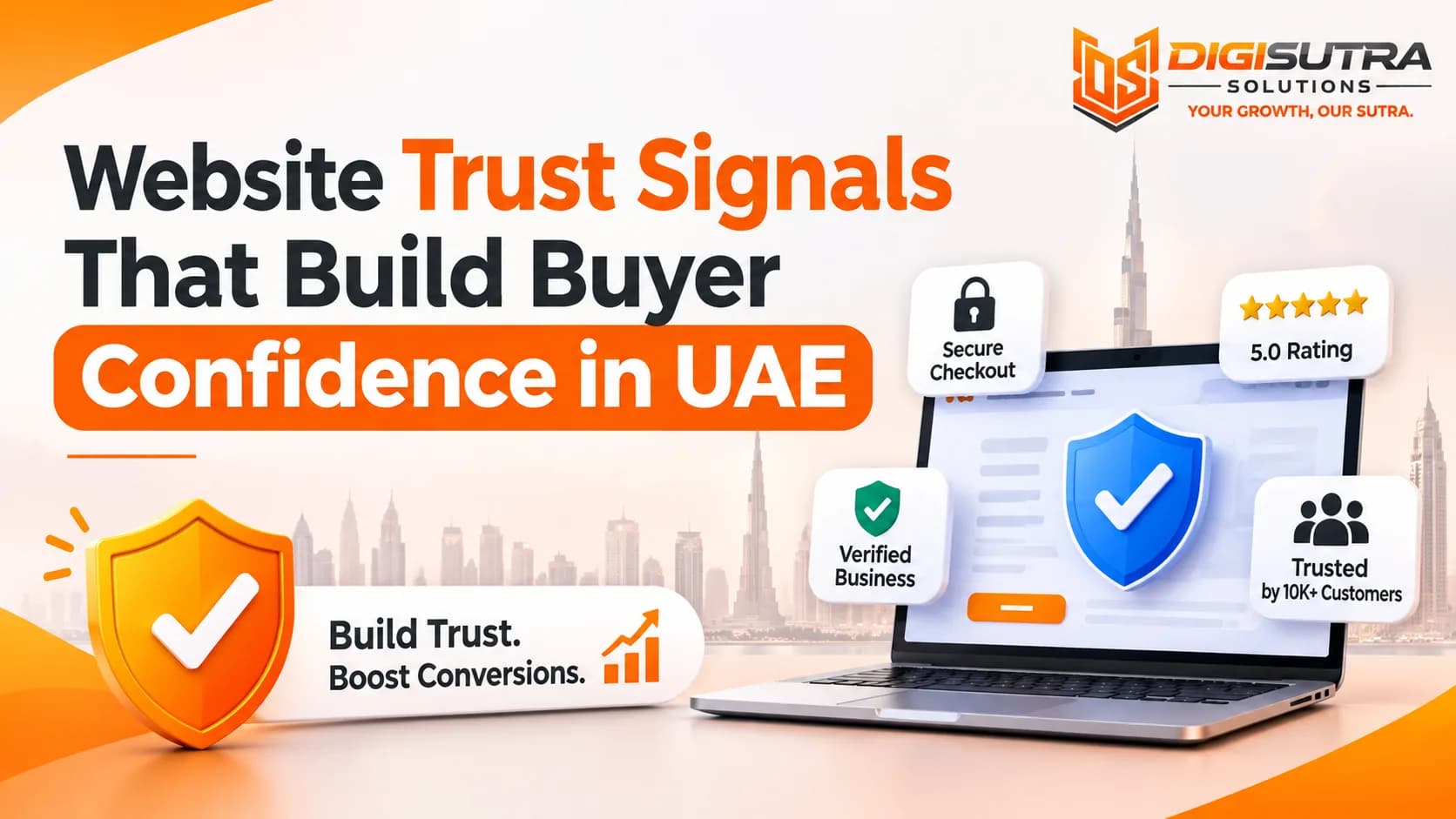
Website Trust Signals That Build Buyer Confidence in UAE
Key takeaways
- A trust signal is any part of your website that tells a visitor you are safe to buy from or contact.
- Anonymous websites lose sales.
- People trust other buyers more than they trust your own claims.
- The checkout is where doubt peaks.
A buyer in Dubai finds your site through a Google search. The design looks fine and the price looks fair. Then the doubts start. Is this company real? Where is it based? Is the card payment safe? What happens if the product is wrong?
Most visitors never say these questions out loud. They close the tab and open a competitor. In the UAE this happens often because the market is full of options and shoppers compare fast. Many of them also remember a bad online order or a scam message that looked just as polished as your page.
Trust signals answer those doubts before the visitor has to ask. They are small proofs on your site that show you are a real, licensed and reliable business. This guide covers the trust signals every UAE website needs and where to place them. It also covers how they help in Google and AI search. The steps are simple and you can start on them this week.
What Trust Signals Are and Why They Matter in the UAE
A trust signal is any part of your website that tells a visitor you are safe to buy from or contact. It can be a license number, a review, a payment logo or a clear return policy. Each one removes a small doubt. Together they make the decision feel safe.
A good trust signals website UAE plan treats every page as a place where trust is won or lost. The homepage, the product page, the checkout and the contact page all need proof in the right spot.
Search engines care about this too. Google's quality rater guidelines name trust as the most important part of E-E-A-T. Experience, expertise and authority all exist to support it. A page that looks untrustworthy gets a low quality rating no matter how expert it claims to be.
The money side is clear as well. Baymard Institute lists distrust over card details at 19% among the reasons US shoppers give for abandoning a cart. Extra costs top the same list at 40%. Those numbers come from US research but the habit is the same in the UAE. A Khaleej Times report on UAE shoppers says 36% name payment security as their top concern when shopping online.
The main types of trust signals
Identity signals such as trade license, address and phone number
Social proof such as reviews, case studies and client logos
Payment and security signals such as HTTPS and secure gateways and wallets
Policy signals such as returns and delivery and privacy pages
Quality signals such as fast pages, clean design and correct Arabic
Authority signals such as expert authors and press mentions and official marks
Show Who You Are With Identity and License Details
Anonymous websites lose sales. A visitor wants to know who is behind the screen and whether the company can be found if something goes wrong.
The UAE e-commerce law raises the bar here. A legal summary from Hadef & Partners on Federal Decree-Law No. 14 of 2023 says digital merchants must make details like website information, physical and digital addresses, contact numbers and the trade license publicly available. Treat that as the minimum. Ask your legal advisor to confirm what applies to your business.
Buyers can also check you. Dubai Economy and Tourism lets anyone look up a trade license by company name or license number on its website. In Abu Dhabi an e-commerce license holder can use the eTajer mark with a unique serial number in promotions. If your public details do not match your license a visitor who checks will notice.
Add the same facts to your Organization schema so Google and AI tools read them the same way. Our guide to structured data for business websites shows which fields matter.
Identity details to show
Trade license number and the issuing authority such as DET, ADDED or a free zone
Registered company name and brand name
Full address with the emirate and a map link
Phone number in +971 format and a WhatsApp number
Email on your own domain and not a free mail address
VAT TRN if you are registered
A team page with real names, photos and roles
An About page with your story and years in business
Official marks such as eTajer if you hold them
Put the license number and TRN in the footer of every page. Put the phone and WhatsApp buttons in the header.
Use Reviews and Proof Buyers Can Check
People trust other buyers more than they trust your own claims. Proof that sits on the page and can be checked elsewhere does the most work.
Real Google reviews and Trustpilot ratings carry weight because visitors can confirm them off your site. Short customer quotes with a name, company and date feel real. Numbers feel even more real. A line like "cut order errors by 30% in two months" beats "great service" every time. Well written case studies and customer stories turn happy clients into your best sales team.
One caution. Never fake or copy reviews. Google also does not allow self-serving reviews on LocalBusiness or Organization pages to earn star snippets. Mark up only reviews that real customers wrote and that visitors can see on the page.
Types of proof and where they work best
Google Business Profile rating beside the main call to action
Three to five short reviews near the price and the form
Case studies with a clear before and after number
Client logos you have permission to use
Video testimonials from real customers
Photos and videos of real work and real staff and real products
Press mentions and award badges that link to the source
Public replies to negative reviews with a calm fix
Make Payments Feel Safe
The checkout is where doubt peaks. The visitor is about to hand over card details. Anything that looks off at this step costs the sale.
Local habits matter here. Khaleej Times reports that cash on delivery use in the UAE has dropped 53% since 2020. More shoppers now pay online and they expect options they already know. Wallets like Apple Pay and Google Pay save typing. Buy now pay later services like Tabby and Tamara are common at checkout. An online store built for secure checkout can offer all of these without slowing the page.
Baymard also found that people judge payment safety by gut feeling and by how secure the form looks. A card field that looks different from the rest of the page can raise doubt even when the system is safe. Keep the form clean and consistent.
Payment trust signals that work
HTTPS on every page and not only on the checkout
A trusted payment gateway with its logos near the pay button
3D Secure for card payments
Apple Pay and Google Pay for one-tap payment
Tabby or Tamara if they fit your price range
Cash or card on delivery for first-time buyers if your category needs it
Guest checkout so visitors do not need an account first
A short line near the button such as "Payments are encrypted" (only if it is true)
Clear order summary with total cost before the final click
Be Clear About Prices and VAT and Policies
Hidden costs break trust faster than almost anything else. Baymard ranks extra costs as the top reason for cart abandonment. A price that grows at the last step feels like a trick.
UAE rules help you here. The Federal Tax Authority says prices shown to consumers must include VAT. The standard VAT rate is 5%. If you are VAT registered your tax invoices must show your TRN. Showing the final price from the first screen is both the legal habit and the trust habit.
Delivery and returns matter just as much. DHL research reported by Arabian Business says 84% of UAE consumers would abandon a purchase if their preferred delivery option is missing. It also says 85% would leave if the returns process does not meet their expectations. Make both easy to find before checkout.
Pricing and policy pages every UAE site needs
Prices in AED with VAT included and visible on first view
Delivery cost and delivery time shown before checkout
A return and refund policy in plain words with a time limit
A warranty page for products that carry one
Terms and conditions that match how you really work
A cancellation and rescheduling policy for services
A complaint contact with a real response time
Tax invoices with your TRN sent after every order
Protect Data and Show Your Privacy Promise
Visitors share their name, phone, email and card details. They want to know where that data goes.
The UAE Personal Data Protection Law is Federal Decree-Law No. 45 of 2021. It came into force on 2 January 2022 and covers how businesses collect and use personal data. DIFC and ADGM have their own data rules. A clear privacy policy and honest consent text are the visible part of compliance. A legal advisor can confirm the details for your case.
Security needs to be visible too. A browser warning or an expired certificate ends a visit in seconds. Old plugins and weak admin logins are what hackers use to place spam on trusted sites. A steady website maintenance and security plan covers updates, backups and monitoring so these problems never reach your visitors.
Security and privacy signals to add
A valid SSL certificate that renews on time
A privacy policy linked in the footer and next to every form
A small cookie banner with clear accept and reject buttons
Short consent text beside forms that says how you will use the data
No pre-ticked marketing boxes
Regular updates for the CMS and plugins and themes
Backups and a firewall on the server
Two-factor login for admin users
A contact route for privacy questions
Only show a badge or certification you actually hold. A fake seal does more harm than no seal.
Let Design and Speed and Content Quality Prove You Are Real
Visitors judge a business in seconds from how the site looks and behaves. Broken links, typos and slow pages all suggest that nobody is paying attention. Tabby's 2026 Middle East shopping survey of 20,999 shoppers in the UAE and Saudi Arabia makes the same point for retail. Its main message is that inconsistency hurts trust more than small flaws.
Speed is part of this. A page that jumps around while loading feels unstable. Pages that pass the Core Web Vitals targets load fast and stay still and respond quickly to taps. That feels professional on a phone in a Dubai mall or on a weak signal in a lift.
Consistency matters just as much as speed. Your logo, colors, tone should match across the site, your social profiles and your ads. Your prices and policies should match across your site and marketplaces and WhatsApp replies.
Quality checks that signal a real business
Main content loads in 2.5 seconds or less on mobile
No layout jumps while the page loads
Same logo, colors and fonts on every page and profile
Original photos of your team, products and work
No broken links and no empty pages
Correct spelling in English and Arabic
Same price and policy on the site and in ads
Text with strong contrast that is easy to read outdoors
Fresh content with visible published and updated dates
Get Arabic and English Right
Many UAE sites serve both languages. This is where trust often slips. An Arabic version that looks half translated tells Arabic readers that they were an afterthought. Raw machine translation and flipped layouts with arrows pointing the wrong way are the usual causes.
Plan both versions together from day one. Our overview of bilingual website design in the UAE explains the process and the cost factors. For trust the key rule is simple. Every proof on the English page needs an equal on the Arabic page. That includes license details, policies, reviews and contact buttons.
Bilingual trust checklist
Show the language switch at the top of every page
Write Arabic copy with a native speaker and not raw machine output
Mirror the layout, menu and forms for right-to-left reading
Repeat license, contact and policy details in Arabic
Keep prices, dates and numbers in one consistent style
Collect reviews in both languages and show both
Link the two versions with hreflang tags
Help Google and AI Tools Trust Your Brand
AI answer tools like Google AI Overviews, ChatGPT and Perplexity build answers from pages they can read fast and verify. One thing they can check is whether the facts about your business match in many places. Your name, address and phone number should read the same on your site, on Google Maps and on social profiles.
An honest note. Nobody outside these platforms can promise a citation. Google has not said that any single trust signal guarantees a place in AI answers. What clear and consistent facts do is make your brand easy to understand and easy to quote. That helps every system that reads your site. Strong SEO and AI search optimization work builds on exactly this base.
Machine-readable trust signals
Organization and LocalBusiness schema that match your Google Business Profile
An About page and author pages with real names and credentials
A short direct answer at the start of each section
Visible published and updated dates on articles
Reviews and mentions on third-party sites such as Google Maps and Trustpilot
The same brand name and description on LinkedIn and Instagram and directories
Mentions of official sources when you quote a rule or a number
A clean technical setup with no crawl errors or broken pages
Trust Signals by Business Type
Different buyers look for different proof. Lead with what your buyer worries about most.
What to show first for each type
Online stores: delivery time, return policy, payment logos and reviews with photos
Real estate: agency and broker registration details and permit numbers where your regulator asks for them and agent profiles
Clinics and healthcare: license numbers from the health authority such as DHA, DOH or MOHAP and doctor profiles with qualifications
B2B services and agencies: case studies with numbers and client logos and team bios and a clear process
Education: accreditation and approvals and course outcomes and student reviews
Legal and finance: license from the regulator and named professionals and clear fee information
Trust Signal Mistakes Common on UAE Websites
Most trust problems repeat from site to site. Spot them early and you save months of lost leads.
Mistakes to fix first
Showing no trade license or address anywhere
Using a free email address for business contact
Posting fake or copied reviews
Stacking many badges that link to nothing
Adding "100% secure" claims with no proof
Hiding delivery fees until the last step
Showing prices without VAT and adding it at checkout
Leaving old offers and expired dates on pages
Running half-translated Arabic pages
Letting the SSL certificate expire
Using different phone numbers on the site and on Google and on social
How to Audit Your Trust Signals in One Week
You do not need a full redesign to start. Most gains come from fixing the gaps on your top pages first.
Finish with a technical check. A full technical SEO audit checklist catches broken links, missing tags and security gaps that weaken trust without anyone noticing.
A simple week plan
Day 1: Open your top five pages on a phone as a stranger would and note every doubt
Day 2: Add or fix identity details such as license, address, phone and TRN
Day 3: Ask five happy customers for reviews and pick one case study to publish
Day 4: Review the checkout and payment options, VAT display and delivery info
Day 5: Check policy pages, the privacy notice and the cookie banner
Day 6: Fix speed issues, broken links and Arabic errors
Day 7: Add schema and match your Google Business Profile and social profiles to the site
Track results before and after. Watch conversion rate, checkout completion, form sends, calls and WhatsApp clicks. Trust work should show up in these numbers within a few weeks.
Conclusion
Buyers in the UAE decide fast and they decide on proof. A licensed business with a clear address and real reviews and safe payments and honest prices looks like a safe choice. A site without these looks like a risk even when the product is great.
Start with identity details and your checkout since they carry the most doubt. Then add proof and clear policies and privacy notes. Keep the design fast and consistent in English and Arabic. Match your facts across Google and social profiles so machines and people read the same story.
Trust is a steady habit and not a one-time task. Check your pages each quarter and update reviews and dates and policies as your business changes. Pick the three biggest gaps from this guide and fix them this week.
FAQ
1. What are trust signals on a website?
Trust signals are parts of your site that show visitors you are real and safe to deal with. Examples include a trade license number, reviews, secure payment logos and clear return and privacy policies. Each one reduces doubt and makes buying feel safer.
2. Why do trust signals matter for UAE websites?
The UAE market is crowded and shoppers compare many options fast. Many also worry about payment security. A Khaleej Times report says 36% of UAE shoppers name it as their top concern. Clear proof helps your site win the visitor who is unsure.
3. Do I need to show my trade license on my website?
If you sell online the UAE e-commerce law expects digital merchants to make details like the trade license and contact information publicly available. Even for service businesses it is a smart habit. Confirm the exact rules for your business with a legal advisor.
4. Which payment options build the most trust in the UAE?
Card payments with 3D Secure and wallets like Apple Pay and Google Pay are the base. Buy now pay later options like Tabby and Tamara suit many stores. Some categories still keep cash or card on delivery for first-time buyers.
5. Should prices on my UAE website include VAT?
Yes for VAT-registered businesses. The Federal Tax Authority says prices shown to consumers must include VAT and the standard rate is 5%. Showing the final price early also stops the shock at checkout that makes shoppers leave.
6. How many reviews does my website need?
There is no fixed number. A handful of recent and detailed reviews with names and dates works better than hundreds of vague ones. Show them near your main button and ask every happy customer for a review after the sale.
7. Do trust badges and security seals work?
They help only when they are real and recognized. A seal you do not hold or a badge that links to nothing hurts trust. Baymard found that people judge security by feel so a clean consistent checkout often matters more than extra badges.
8. Do trust signals help SEO and AI search?
Yes in a practical way. Google's guidelines place trust at the center of E-E-A-T. Clear business details, real reviews and consistent facts also help AI tools read and quote your brand. No one can guarantee a citation but the base is the same.
9. How long do trust signal changes take to show results?
Visitor behavior can change within days or weeks once identity details, policies and checkout fixes go live. Search and AI visibility take longer and depend on your wider SEO work. Track conversion rate and checkout completion before and after.
10. How can I check if my website looks trustworthy?
Open your top pages on a phone as a stranger and write down every doubt. Check that your license, address and phone are visible and that prices include VAT. Then ask a few new customers what almost stopped them from buying.
About the author

Sr. SEO Executive · 3 years' experience
Harsh Rajput is a Senior SEO Executive with 3+ years of experience in SEO, digital marketing and AEO/GEO strategy. He leads a team of SEO executives at Digisutra Solutions, handling keyword research, technical SEO, on-page/off-page optimization, link building and content strategy, while helping brands rank in Google AI Overviews and LLM platforms like ChatGPT, Claude and Gemini. He has worked with clients across India, USA, UAE, and Australia in industries like e-commerce, finance and technology.
Reader reviews
Up next · Web & design · 18 min
Website Animation Design Services in UAE: Fast and Smooth
Related · SEO & AI search · 13 min
Core Web Vitals SEO Services in UAE to Boost Speed