

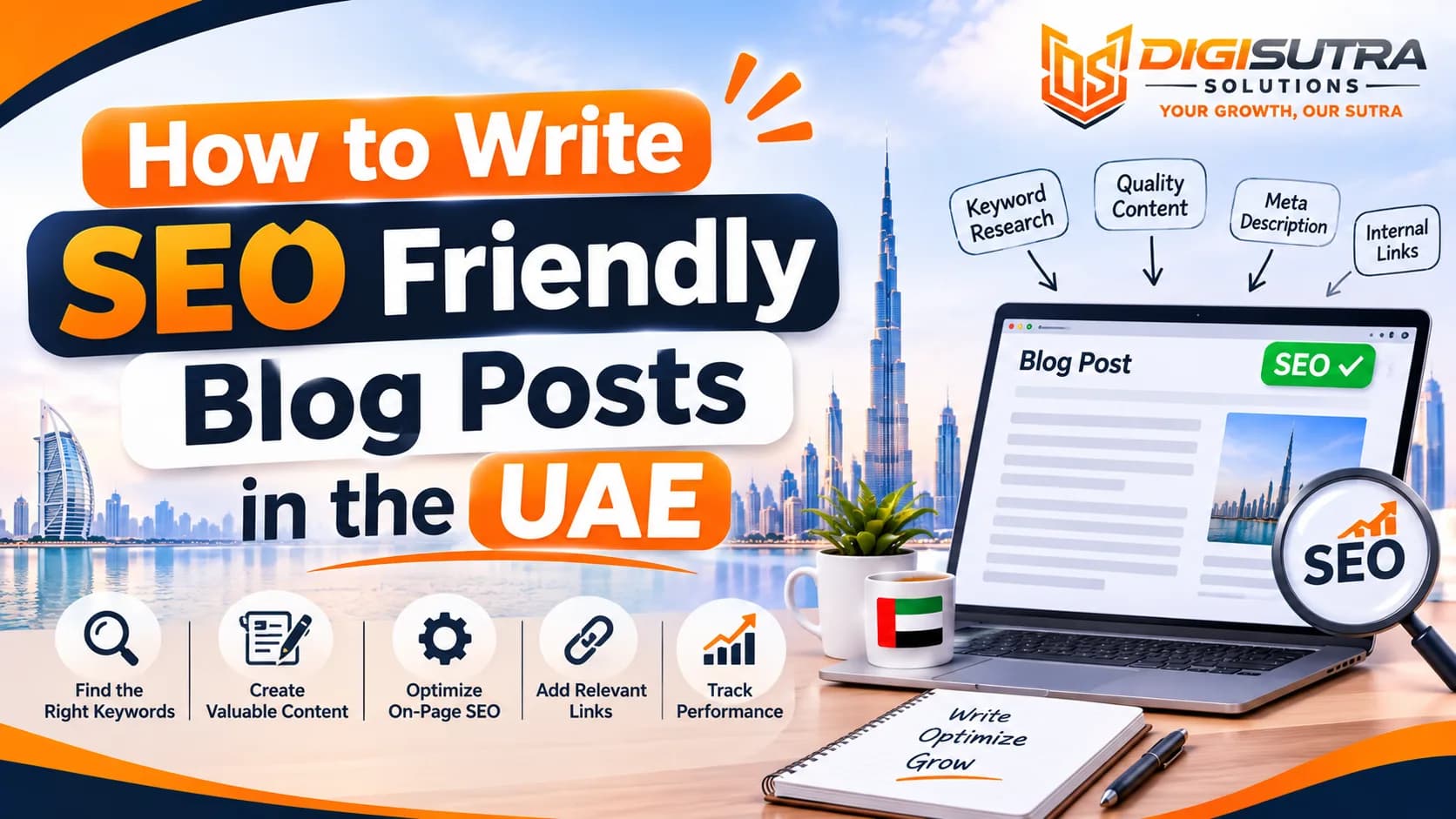
How to Write SEO Friendly Blog Posts in the UAE
Key takeaways
- Many blogs never reach page one because they skip the basics.
- Keyword research is not picking a phrase with high search volume.
- A direct Arabic translation of an English post rarely ranks.
- Structure decides whether someone stays on your page or leaves within seconds.
A property firm in Dubai publishes four blog posts a month. Each one is 1,500 words. After a year none of them sits on page one. The posts talk about the firm and not about what buyers actually search for. The Arabic readers get nothing at all.
Ranking on Google is not about luck or tricks. It comes from content that answers real questions clearly, a structure that readers and search engines both understand. Most blog posts fail because they chase word count and not a reader's problem.
This guide shows how to write SEO friendly blog posts that rank and get read in the UAE. It also shows how to get picked up by AI tools like ChatGPT and Google AI Overviews. You get a clear process you can follow for every post.
Why Most Blog Posts Fail to Rank
Many blogs never reach page one because they skip the basics. Writers chase keywords without checking what the reader wants. Search engines reward content that solves a problem fast and clearly.
Common Reasons Blog Posts Do Not Rank
No clear match to search intent
Weak or missing heading structure
Thin content with no real value
Slow page speed and poor mobile experience
No internal linking or topic depth
English only content for a market that also searches in Arabic
Ignoring the basics of on-page SEO
Fixing these issues comes before you write a word. A solid plan from a team that offers SEO content writing services in UAE starts by finding out why your current posts are not performing.
Start With Real Keyword Research for the UAE
Keyword research is not picking a phrase with high search volume. You need to understand what the searcher wants to see when they type that query.
Search habits in the UAE are mixed. People search in English and in Arabic. Some type Arabic words in Latin letters. Many add a city name such as Dubai, Abu Dhabi or Sharjah. Check each language on its own because the top results and the intent can differ.
Steps for Better Keyword Research
Search your target keyword on google.ae and study the top five results
Note the format Google prefers such as a list, guide or comparison
Check People Also Ask questions for subtopics
Repeat the search in Arabic and compare the results
Find low competition long tail variations with a city or area name
Group similar keywords into one page instead of splitting content
Once you know the intent you can build a content plan that satisfies the query and does not guess.
Plan Arabic and English Content Together
A direct Arabic translation of an English post rarely ranks. Arabic readers use different words, different examples. Dialect and formal Arabic also read differently. Pick the style your readers use and keep it steady across the post.
Give each language its own URL. Link the two versions with hreflang tags using en-AE and ar-AE. Let a native writer handle the Arabic version and have a second person read it before you publish.
Bilingual Content Rules
Write the Arabic post from the same outline and not word by word
Use Arabic keywords that real people search
Keep titles and meta descriptions in both languages
Use right-to-left layout and an Arabic font made for screens
Keep facts and numbers the same in both versions
Do not auto redirect visitors by browser language
Structure Your Blog Post for Readers and Search Engines
Structure decides whether someone stays on your page or leaves within seconds. Search engines also use structure to understand what your page covers.
Structure Elements That Matter
One clear H1 title with the main keyword
H2 sections that break the topic into logical parts
H3 sub-points or lists under each H2
Short paragraphs of two to three lines
Bullet points for lists and steps
A clear introduction and conclusion
This layout also helps your content get picked up in Google AI Overviews and answer boxes. Machines scan structured content faster than long unbroken paragraphs.
Write in Simple and Direct Language
Complicated language slows readers down and raises bounce rate. Simple language keeps people reading and helps search engines match your content to more queries. It also suits a UAE audience where many readers use English as a second language.
Tips for Simple Writing
Use short sentences with one idea each
Avoid jargon unless your audience expects it
Replace long words with common ones
Read your content out loud to catch awkward phrasing
Cut every sentence that does not add value
Writing simply is not writing poorly. It is writing so anyone can understand your point on the first read.
Optimize On-Page SEO Elements
On-page SEO tells Google exactly what your page is about. Missing these basics can hold back even the best written content.
On-Page Checklist
Add the primary keyword in the title and first paragraph
Use descriptive URL slugs
Write a compelling meta description
Add alt text to every image
Link to relevant internal pages
Keep keyword usage natural and not forced
Add your city or service area where it fits the topic
If your site needs a deeper review a technical check can catch gaps you might miss. A free SEO audit tool shows missing titles, slow pages and broken links in minutes.
Make Your Content AI and Answer Engine Friendly
Google AI Overviews, ChatGPT and other AI tools now pull answers directly from web content. If your blog post is not built for extraction it gets skipped.
How to Optimize for AEO and GEO
Answer the main question in the first two to three sentences
Use clear headings that match common search queries
Add short definition style answers under each H2
Include stats, data points where possible and name the source
Use FAQ sections with direct answers
Avoid burying the answer under long intros
Keep your business name, details the same across your site and profiles
This approach is called Answer Engine Optimization or Generative Engine Optimization. It is quickly becoming as important as traditional SEO. For UAE topics such as company setup, visas or healthcare rules add the date you last checked the facts. Rules change and fresh dates build trust.
Show Real Experience and Trust
Google looks for signs that a real expert wrote the post. This is part of E-E-A-T. In the UAE it matters most for topics where bad advice costs money or health such as law, finance, medicine and property.
Trust Signals to Add
A named author with a short bio and a profile page
First-hand examples from your own work
Sources for every figure
A visible date for publishing and for the last update
Clear business details and a way to contact you
Use Internal Linking the Right Way
Internal links help search engines understand your site structure and help readers find more useful content without leaving your site.
Internal Linking Best Practices
Link to relevant service or resource pages naturally
Avoid stacking multiple links in one paragraph
Use descriptive anchor text and not "click here"
Spread links across different sections and not just one
Never force a link where it does not fit
Good internal linking also keeps visitors exploring more of your site which signals quality to search engines.
Add Visuals and Break Up Text
Long blocks of text without a visual break feel tiring to read. Visuals also explain ideas faster than words alone. Most UAE visitors read on a phone so short blocks matter even more.
Visual Elements to Include
Relevant images with proper alt text
Simple charts or comparison tables
Screenshots for tutorials and how-to content
Bullet lists instead of dense paragraphs
Bold text to highlight key points
Even small choices like bold text or spacing can improve how long readers stay on your page.
Edit and Proofread Before Publishing
A great first draft is not a finished article. Editing removes fluff, tightens sentences and fixes errors that hurt trust.
Editing Checklist
Remove repeated words and phrases
Check for logical flow between sections
Verify all facts and statistics
Fix grammar and spelling errors in both languages
Read the whole post from a reader's point of view
Confirm the primary keyword appears naturally throughout
Skipping this step is one of the most common reasons otherwise good content underperforms.
Track Performance and Update Regularly
SEO is not a one-time task. Rankings shift and content that performed well a year ago may need a refresh today.
What to Track After Publishing
Organic traffic and keyword rankings
Average time on page and bounce rate
Click through rate from search results
New keyword opportunities in Search Console
Competitor content updates
Regularly updating old posts with fresh data and better structure often works better than publishing new content from scratch. Put the numbers in one KPI dashboard so you can see which posts earn traffic and which need work.
Conclusion
Writing content that ranks is a mix of clear structure, simple language and real value for the reader. Focus on answering the query fast. Use headings that guide the reader and keep your on-page basics tight.
When you combine solid keyword research in both languages with content built for people, AI search tools your blog has a real chance of ranking and staying there. Treat every post as something to improve over time and not as a one-time task.
Frequently Asked Questions
1. What makes a blog post SEO friendly?
A blog post is SEO friendly when it matches search intent, uses clear headings, includes the target keyword naturally and loads fast on all devices.
2. How long should an SEO blog post be?
Length depends on the topic but most ranking posts fall between 1,200 and 2,000 words. Focus on covering the topic fully and not on hitting a number.
3. How many keywords should I use in one post?
Focus on one primary keyword and a few related terms. Forcing too many keywords into one post can hurt readability and rankings.
4. Should I write blog posts in Arabic as well as English?
If your customers search in Arabic then yes. Write the Arabic post with a native writer and give it its own URL. Link both versions with hreflang tags.
5. What is AEO and why does it matter?
AEO stands for Answer Engine Optimization. It means structuring content so AI tools and answer boxes can pull direct answers from your page.
6. How often should I update old blog posts?
Review top performing posts every three to six months. Update outdated stats, broken links and thin sections to keep rankings steady. Rules in the UAE change often so check legal and tax facts more often.
7. Should I use short or long paragraphs for SEO?
Short paragraphs of two to three lines work best. They are easier to scan on mobile and keep readers engaged longer.
8. How many internal links should a blog post have?
There is no fixed number but three to five relevant internal links spread naturally through the post is a good practice for most articles.
9. Can AI written content rank on Google?
Yes if it gives real value, shows real experience, edited for accuracy and tone. Quality matters more than who wrote it.
10. What is the fastest way to improve an old blog post's ranking?
Update the content with fresh information and improve the heading structure. Add missing internal links and make sure it directly answers the target query.
About the author

Sr. SEO Executive · 3 years' experience
Harsh Rajput is a Senior SEO Executive with 3+ years of experience in SEO, digital marketing and AEO/GEO strategy. He leads a team of SEO executives at Digisutra Solutions, handling keyword research, technical SEO, on-page/off-page optimization, link building and content strategy, while helping brands rank in Google AI Overviews and LLM platforms like ChatGPT, Claude and Gemini. He has worked with clients across India, USA, UAE, and Australia in industries like e-commerce, finance and technology.
Reader reviews

Up next · SEO & AI search · 13 min
Core Web Vitals SEO Services in UAE to Boost Speed
Related · SEO & AI search · 21 min
Schema Markup SEO Services in UAE: Types and Cost